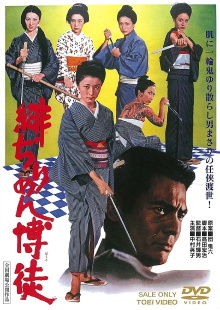
With her first love that unfolded in the battlefield in her heart, and with a short sword and a pillbox as her weapons, female gambler Okatsu the Tiger Lily travels from gambling site to gambling site. Surrounding her are Omon, an outlaw star blind lone gambler; Onaka, a thief who’s after Okatsu to avenge her father’s death; Ohide, a tattoo artist whose back is covered by a dragon tattoo; and Oryu, a young girl sold as a prostitute to a gambling family.
Kasuga’s husband gets arrested for a murder of his beloved protégé. She and her family investigate and find out he was trapped by greedy Nagoshi, the boss of their rival yakuza family.
In order to settle a business dispute, a mob leader murders one of his own teenage sons. The surviving son vows to avenge his brother's death, and organizes his own gang of teenage killers to destroy his father's organization.
Tamaki's (Iwashita) husband is the head of the Idei clan, based in southern Osaka. As the film opens, punch-permed lieutenant Ginji (Riki Takeuchi) is killed while pumping iron.
Akemi is a dragon tattooed leader of the Tachibana Yakuza clan. In a duel with a rival gang Akemi slashes the eyes of an opponent and a black cat appears, to lap the blood from the gushing wound.
In Brazil, Akemi finds out that she's the heiress to the Yakuza empire. Just after that, her destiny enters a spiral of violence and mystery, where a gaijin (foreigner) who's been protecting her all this time, Shirô, may have been actually sent to kill her.
Taking place in Shinshu in the 1920s, Tsumakoi Okoma, while traveling to hone her gambling skills, teams up with the vagabond Tsukuba Tsuneji and comes into conflict with gamblers plotting to take over a rustic hot-spring town.
Popular movie trailers from 1972
These some of the most viewed trailers for movies released in 1972:
This Spanish-Italian co-production tells the story of a man who feels deep guilt for the death of his wife: he, an alcoholic, is convinced that he accidentally caused her fatal fall in their house while he was drunk.
Young adventurer Gipo owns one fifth of a rock illustrating the location of a rich gold mine. Risking his life more than once and with the help of the beautiful hooker, Lulu Belle, our hero sets out to recover the missing pieces.
After a Chinese restaurant in Rome is threatened by the mafia, who will stop at nothing to acquire the property, the owner recruits a family friend in Hong Kong, kung fu expert Tang Lung, to help them defend their business.
Doc Saxon and his gang rob the Crown City bank but are double-crossed by Carrasco, a Mexican bandit, who steals the gold and leaves Doc and Donovan with nothing.
Comments
Have you watched The Red Silk Gambler yet? What did you think about it?