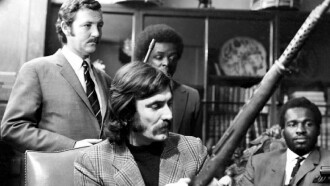
"Educating 1960s campus protesters as to "what's right with America.""01 January 1972History, Factual24 mins
Contrasting radical mobs, anarchy, and 1960s counterculture with footage of American manufacturing and innovation, this film celebrates the concept of American exceptionalism and argues that anti-Vietnam War protesters were influenced by communism, atheism, and immorality. Set mostly in a university library, this political debate between a medical student, his 1770s ancestor, and a history professor is a sequel to the 1972 National Education Program film, Brink of Disaster! Two additional characters appear in this drama: a 19th-century steamboat captain, and the student’s grandfather - an early 20th-century automobile worker. The National Education Program at Harding College in Searcy, Arkansas created a variety of widely-distributed anti-communism films from the mid-1940s to the early 1970s.
Three stories told simultaneously in ninety minutes of real time: a Republican Senator who's a presidential hopeful gives an hour-long interview to a skeptical television reporter, detailing a strategy for victory in Afghanistan; two special forces ambushed on an Afghani ridge await rescue as Taliban forces close in; a poli-sci professor at a California college invites a student to re-engage.
The story of the Cuban Missile Crisis in 1962—the nuclear standoff with the USSR sparked by the discovery by the Americans of missile bases established on the Soviet-allied island of Cuba.
A disturbing collection of 1940s and 1950s United States government-issued propaganda films designed to reassure Americans that the atomic bomb was not a threat to their safety.
Tommy Robinson goes on the offensive by documenting how his own “hit piece” on his character was being constructed by the taxpayer-funded BBC for their popular investigative news special “Panorama.
An intimate look at the Woodstock Music & Art Festival held in Bethel, NY in 1969, from preparation through cleanup, with historic access to insiders, blistering concert footage, and portraits of the concertgoers; negative and positive aspects are shown, from drug use by performers to naked fans sliding in the mud, from the collapse of the fences by the unexpected hordes to the surreal arrival of National Guard helicopters with food and medical assistance for the impromptu city of 500,000.
In 1987 Korea under an oppressive military regime, the unlawful interrogation and death of a college student ignite ordinary citizens to fight for the truth and bring about justice.
Paul, a former womanizer, marries the head of the medical department's "unattractive" daughter Christine because he thinks attractive women can't be trusted and make poor wives.
After having challenged the German Ottone to single combat for the hand of Leonza, the bishop's niece, the valiant knight Anselmo da Montebello, leaves for Rome where he must deliver a precious relic to the Pope and obtain a sum of twenty-thousand crowns in order to participate in the third crusade in the Holy Land.
“It’s not how it used to be.” The words of Cézar Néwashish resonate throughout this short documentary that explores the history of the Atikamekw community of Manawan, Quebec.
In a French seaside town, at a boarding house for civil servants recovering from surgery and maladies, the six male residents' lives change dramatically when two women arrive: Catherine, lively, sexually liberated, willing to kiss, dance, and sleep with the men, and Leonie, reserved, formal, conservative.
Comments
Have you watched Tragedy or Hope yet? What did you think about it?