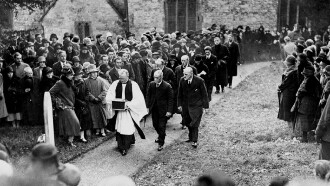
In a programme first broadcast in 1973 as he entered his 80th year, JB Priestley chooses extracts from his own writing to celebrate some of the many things that he looks back on with pleasure.
A radical cinematic investigation into the myth of Hamlet, the avenging prince of Denmark, William Shakespeare's creature; his origins and his unending influence on many diverse cultures.
A portrait of the British writer Thomas Hardy (1840-1928), who, although he had radical instincts, hated hypocrisy, was of great poetic brilliance, had a tragic perception of life and a calm outward appearance, was at heart a man of seething and somber darkness.
British author Agatha Christie (1890-1976) is the world's most translated author: her heroes, private detective Hercule Poirot and amateur sleuth Miss Marple, are known the world over.
England, 1890s. The brutal and embittered Marquis of Queensberry, who believes that his youngest son, Bosie, has an inappropriate relationship with the famous Irish writer Oscar Wilde, maintains an ongoing feud with the latter in order to ruin his reputation and cause his fall from grace.
A fascinating exploration of the literary — The Tragedy of Othello, the Moor of Venice, by English playwright William Shakespeare (1604) — and lyrical — Othello, by Italian opera composer Giuseppe Verdi (1887) — myth of Othello, the desperately tragic story of a Moorish general in the army of the Venetian Republic whose absurd jealousy poisons his love for his wife Desdemona.
Crime writer Ian Rankin investigates The Strange Case of Dr Jekyll and Mr Hyde. Starting with Robert Louis Stevenson's nightmare in September 1885, Rankin traces the roots of this story, which stretches back to Stevenson's childhood.
The story of the cross destiny of George Orwell (1903-50) and Aldous Huxley (1894-1963), the genius authors of the two most groundbreaking novels of anticipation of the 20th century: 1984 and Brave New World; two lucid witnesses of the maledictions of the modern world whose novels have found a considerable echo with our time.
British writer Agatha Christie (1890-1976) published her first novel in 1920, in which the eccentric Belgian private sleuth Hercule Poirot made his debut.
Sandro, a detective, finds his wife strangled. His girl-friend Tiffany, who works as photographer, makes a "Blow up" from a photo, what Sandro finds beside the victim.
Abel Hradscheck, the owner of an inn in the Oderbruch country, faces financial ruin. For this state of affairs, Ursula, his wife and former actress, is by no means free of blame.
A couple is suffering from sexual estrangement. The husband is having an affair with his secretary and the wife takes up with Sandra an interior decorator.
Two rival street gangs from Kowloon go to war over turf and bar girls so as to dominate the area and maximize their takings; however things go from bad to worse as the girls start to get involved in the bloody feud.
An edited version of the 1970 German documentary "Erinnerungen an die Zukunft" (Chariots of the Gods), this examines the theory that aliens have landed on Earth in ancient times and were responsible for many of mankind's oldest mysteries.
Shanta Dhamle lives a wealthy lifestyle in Bombay along with her dad, Shamrao, and mom, Ansuya. She incurs their displeasure when she falls in love and gets married to a poor and overly sensitive writer, Gopal, who moves in with them, and continues to suffer verbal abuse at Shamrao's hands.
It is 1905. The police director gets Jindrich Legenda (Eduard Cupák) shadowed as, yet Legenda had served his sentence for a burglary, the jewels have not been found.
In this film the director's recurring concerns return: the divisions in the Chilean left, and its contradictions between what the director calls the "traditional" and the "revolutionary" left.
Comments
Have you watched An Evening with J.B. Priestley yet? What did you think about it?