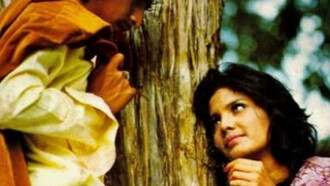
After the death of his eldest son, who fell victim to a disease transmitted by white people, the Indian Uirá, chief of the Urubú tribe, decides to set off in search of the god Maíra, creator of the world of men, with whom only brave warriors of the forest are reunited after death. Uirá will also encounter the 'civilisation' of the new Brazil.
Two rival street gangs from Kowloon go to war over turf and bar girls so as to dominate the area and maximize their takings; however things go from bad to worse as the girls start to get involved in the bloody feud.
An edited version of the 1970 German documentary "Erinnerungen an die Zukunft" (Chariots of the Gods), this examines the theory that aliens have landed on Earth in ancient times and were responsible for many of mankind's oldest mysteries.
Shanta Dhamle lives a wealthy lifestyle in Bombay along with her dad, Shamrao, and mom, Ansuya. She incurs their displeasure when she falls in love and gets married to a poor and overly sensitive writer, Gopal, who moves in with them, and continues to suffer verbal abuse at Shamrao's hands.
The story of a peasant whose harshness and bluntness only provoke disputes and anger, and his honesty and sense of truth and honor in conjunction with the previous qualities only exacerbate these disputes.
In this film the director's recurring concerns return: the divisions in the Chilean left, and its contradictions between what the director calls the "traditional" and the "revolutionary" left.
It is 1905. The police director gets Jindrich Legenda (Eduard Cupák) shadowed as, yet Legenda had served his sentence for a burglary, the jewels have not been found.
Abel Hradscheck, the owner of an inn in the Oderbruch country, faces financial ruin. For this state of affairs, Ursula, his wife and former actress, is by no means free of blame.