The silent majority is the Costa Rican peasantry, which has been the object of traditional contempt and which has manifested itself in various forms: unfair salary compensation, bad prices for their agricultural products, financing difficulties, land grabs, precarious housing and educational conditions. health. Precariousness, peasant migrations and the depletion of the agricultural frontier are also analyzed in the film.
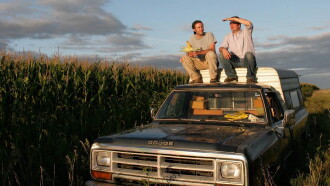
King Corn is a fun and crusading journey into the digestive tract of our fast food nation where one ultra-industrial, pesticide-laden, heavily-subsidized commodity dominates the food pyramid from top to bottom – corn.
At the turning point of the Iran-Contra affair, Elena McMahon, a fearless investigative journalist covering the 1984 US presidential campaign, puts herself in danger when she abandons her assigned task in order to fulfill the last wish of her ailing father, a mysterious man whose past activities she barely knows.
Documentary filmmaker Robert Kenner examines how mammoth corporations have taken over all aspects of the food chain in the United States, from the farms where our food is grown to the chain restaurants and supermarkets where it's sold.
Bhoominathan, a NASA scientist, returns to his drought-affected village in Tamil Nadu and decides to fight against the evil corporates and corrupt politicians responsible for the plight of his people.
An Algerian man's life-long dream finally comes true when he receives an invitation to take his cow Jacqueline to the Paris International Agriculture Fair.
The philanthropic foundation set up by US billionaire Bill Gates quietly co-finances experiments with genetically modified organisms (GMOs) in several African countries.
"A Home On The Range" tells the little-known story of Jews who fled the pogroms and hardships of Eastern Europe and traveled to California to become chicken ranchers.
Two friends named Amir Palang and Ahmad Nane Baba Jegaraki are interested in Asieh ; But Asieh is interested in Amir, and Amir tries to stay away from Asieh in favor of Ahmad.
Female gladiators fight to the death. Inspired by the story of Spartacus, follow the adventures of a bevy of slave girls who, upon finding themselves thrust into the gladiator ring, mount a vicious rebellion to fight their way to freedom.