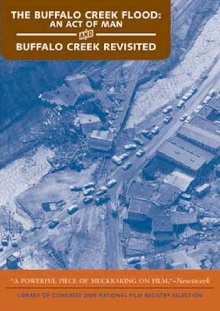
In 1972 a coal-waste dam owned by the Pittston Company collapsed at the head of a crowded hollow in southern West Virginia. A wall of sludge, debris, and water tore through the valley below, leaving in its wake 125 dead and 4,000 homeless. Interviews with survivors, representatives of union and citizen’s groups, and officials of the Pittston Company are juxtaposed with actual footage of the flood and scenes of the ensuing devastation. As reasons for the disaster are sought out and examined, evidence mounts that company officials knew of the hazard in advance of the flood, and that the dam was in violation of state and federal regulations. The Pittston Company, however, continued to deny any wrongdoing, maintaining that the disaster was an “act of God.”
In the Realms of the Unreal is a documentary about the reclusive Chicago-based artist Henry Darger. Henry Darger was so reclusive that when he died his neighbors were surprised to find a 15,145-page manuscript along with hundreds of paintings depicting The Story of the Vivian Girls, in What is Known as the Realms of the Unreal, of the Glodeco-Angelinnian War Storm, Cased by the Child Slave Rebellion.
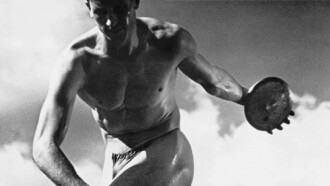
Starting with a long and lyrical overture, evoking the origins of the Olympic Games in ancient Greece, Riefenstahl covers twenty-one athletic events in the first half of this two-part love letter to the human body and spirit, culminating with the marathon, where Jesse Owens became the first track and field athlete to win four gold medals in a single Olympics.
The image of a mysterious, solitary filmmaker - a cineaste maudit - who flees from both the media and the public, is unrelentingly bound to the figure of Leos Carax, in France.
This made-for-television documentary tells the story of the creation of the world's most successful musical, Andrew Lloyd Webber’s The Phantom of the Opera.
Part two of Leni Riefenstahl's monumental examination of the 1938 Olympic Games, the cameras leave the main stadium and venture into the many halls and fields deployed for such sports as fencing, polo, cycling, and the modern pentathlon, which was won by American Glenn Morris.
Shut Up and Sing is a documentary about the country band from Texas called the Dixie Chicks and how one tiny comment against President Bush dropped their number one hit off the charts and caused fans to hate them, destroy their CD’s, and protest at their concerts.
Julia Sweeney's third autobiographical monologue, Letting Go of God takes the audience through her Catholic upbringing and how personal events in her life and that of her family led her to a disbelief in a personal universal deity.
Comedian Bonnie McFarlane dons her investigative journalist's hat to find out once and for all if women are funny and report her unbiased findings in what some are calling the most important documentary of our generation.
The story of Pixar's early short films illuminates not only the evolution of the company but also the early days of computer animation, when a small group of artists and scientists shared a single computer in a hallway, and struggled to create emotionally compelling short films.
In the early twentieth century, the Hotel Nueva Isla was an emblematic luxury hotel. After the Cuban Revolution, it was confiscated by the State and became a shelter for homeless people.
Popular movie trailers from 1975
These some of the most viewed trailers for movies released in 1975:
A married couple, after a life time of work and bringing up a family, retire and awaken to the fast changing world around them, the habitual nature of their relationship, and what they have left.
Gardener Napoleone takes a job in a southern-Italian villa and quickly finds himself embroiled in a menage-a-trois with Paola and her mother, which soon leads to sex, death and mayhem.
Dr. Siva treats leprosy patients and gives great importance to his patients' care. When Geetha falls in love with him, he marries her expecting that she would understand the hassles of his profession.
Adapted from the novel Die Döppelgänger by Theodor Storm, this black-and-white drama tells the tragic story of a war veteran who, in 1860, returns to his home in Schleswig Holstein after serving a term for robbery.