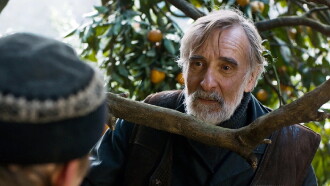
Despite the fact that the film is a documentary, its lead character and his life story are fictitious, though very probable. It is one of the best examples of creative documentary film-making of Wojciech Wiszniewski.
A 59-year-old carpenter recovering from a heart attack befriends a single mother and her two kids as they navigate the impersonal, Kafkaesque benefits system.
War in Abkhazia, 1992. An Estonian man Ivo has stayed behind to harvest his crops of tangerines. In a bloody conflict at his door, a wounded man is left behind, and Ivo is forced to take him in.
It is an animated adaptation of Lewis Carroll's whimsical poem in which the walrus and the carpenter entice a family of oysters to join them on their journey along the beach.
A married woman and her lover plot to kill her husband to make off with the insurance money. However, their attempt to murder him using poisonous fish toxins backfires in surprising ways.
Sophia is a philosophy professor in Montreal and has lived as a couple with Xavier for 10 years. Sylvain is a carpenter in the Laurentians and must renovate their country house.
At the end of the 19th century, during a ball in Joinville, on the outskirts of Paris, Georges, a former delinquent working as a carpenter, meets Marie, a young woman connected to a criminal gang.
Suffering from insomnia, disturbed loner Travis Bickle takes a job as a New York City cabbie, haunting the streets nightly, growing increasingly detached from reality as he dreams of cleaning up the filthy city.
Film in three segments. In the first, father is suspicious about his son's masculinity. The second one shows a Don Juan-like guy who, at church for his own wedding, cannot remember who the bride might be.
Cornélio, an aged man and famous baritone, marries the young Angelica, who plans with her ex-boyfriend Bruno, to kill the husband with contaminated oysters, but she ends up the one who gets sick.
About August Strindberg's marriage to Siri von Essen. She was married when she met him, but abandoned her husband, became Strindberg's mistress and later his wife.
In post-Civil War Kentucky, young David Burnic becomes the unexpected heir to the family secret, a map leading to buried treasure on the Florida isle of Matecumbe.
The story Peter is telling the about a special summer, when he is invited over to summer holiday from bickering parents, to his aunt and uncle in the country.
Comments
Have you watched A Carpenter yet? What did you think about it?