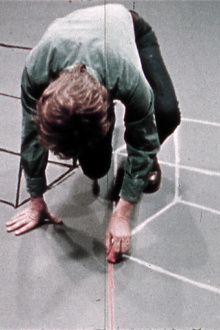
Cube and Room Drawings begins with a view looking down at an angle toward grey paper covering the floor. A performer enters from the back of the scene and begins drawing lines on the floor. The lines are the beginning of a drawing of a distorted cube. The performer leaves the scene. The paper begins to rotate on the floor. As the paper rotates the cube gradually becomes correctly oriented, as if it were drawn on a vertical piece of paper. The performer enters again and draws another cube that corresponds to the perspective of the other cube. After leaving and re-entering the performer draws red receding lines on the floor. He leaves and the paper rotates and the red lines become a grid that corresponds to the vertical screen. The film continues with several additional actions that continue this theme. Preserved by the Academy Film Archive in 2012.
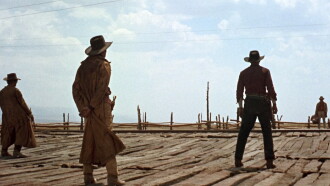
As the railroad builders advance unstoppably through the Arizona desert on their way to the sea, Jill arrives in the small town of Flagstone with the intention of starting a new life.
As the west rapidly becomes civilized, a pair of outlaws in 1890s Wyoming find themselves pursued by a posse and decide to flee to South America in hopes of evading the law.
Wallace's whirlwind romance with the proprietor of the local wool shop puts his head in a spin, and Gromit is framed for sheep-rustling in a fiendish criminal plot.
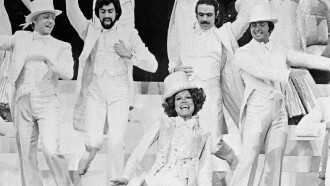
Double or Nothing is a 1936 American short musical comedy film directed by Joseph Henabery. It was nominated for an Academy Award at the 9th Academy Awards in 1936 for Best Short Subject (Two-Reel).
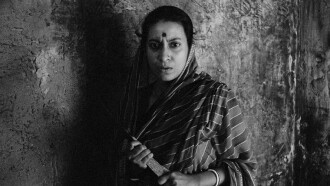
Apu and his family have moved away from the country to live in the bustling holy city of Benares. As he progresses from wide-eyed child to intellectually curious teenager, eventually studying in Kolkata, we witness his academic and moral education, as well as the growing complexity of his relationship with his mother.
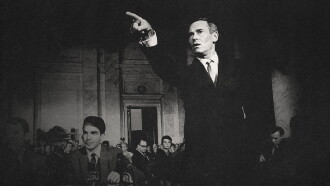
Proposed by the President of the United States to fill the post of Secretary of State, Robert Leffingwell appears before a Senate committee, chaired by the idealistic Senator Brig Anderson, which must decide whether he is the right person for the job.
Apu, now a jobless ex-student dreaming vaguely of a future as a writer, is invited to join an old college friend on a trip up-country to a village wedding.
Letter carrier Eva is in her late twenties, unmarried and the mother of a twelve-year-old son. She falls in love with Jon, a bargeman who is unfortunately already engaged.
The title of Truth Through Mass Individuation references Carl Jung. An isolated figure is seen performing successively more aggressive actions — dropping a cymbal among a flock of pigeons, firing a rifle in a deserted city street.
An extended dream sequence presents a biblical allegory about the creation, downfall and rebirth of humanity, told through a series of surrealistic vignettes and musical numbers.
The film revolves around the manin protagonist Meenakshi (K. R. Vijaya), who rises from an ordinary housewife to become a Mayor and the trials and tribulations she face to maintain a balance at work and at home.
Comments
Have you watched Cube and Room Drawings yet? What did you think about it?