This film deals with the fate of children during the Second World War. The Nazis divided children into two categories: “the good ones,” the Aryan children, and “the bad ones,” the others. In the name of ultranationalism, Nazism, the theory of the Übermensch, and racism, Aryan children were mentally indoctrinated, while the others were imprisoned in camps and physically destroyed.
These “others” were mainly children from non-Aryan and supposedly impure races: Jews, Poles, Russians, Yugoslavs, and Roma.
For this film, Lydia Chagoll conducted research in World War II documentation centers, museums, and concentration camp archives in several countries, collecting texts, documents, and photographs. The film consists of a montage of photos and footage filmed by the Nazis themselves, accompanied by voice-over commentary based entirely on quotations from Nazi publications, laws, decrees, directives, newspapers, schoolbooks, reports, and political texts.
Alex Jones exposes the problem-reaction-solution paradigm being used to terrorize the American people into accepting a highly controlled and oppressive society.
One journalist described it as a chance "to see justice catch up with evil." On November 20, 1945, the twenty-two surviving representatives of the Nazi elite stood before an international military tribunal at the Palace of Justice in Nuremberg, Germany; they were charged with the systematic murder of millions of people.
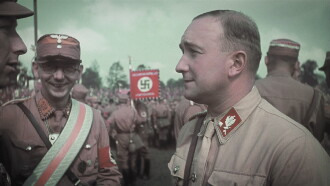
What would your family reminiscences about dad sound like if he had been an early supporter of Hitler’s, a leader of the notorious SA and the Third Reich’s minister in charge of Slovakia, including its Final Solution? Executed as a war criminal in 1947, Hanns Ludin left behind a grieving widow and six young children, the youngest of whom became a filmmaker.
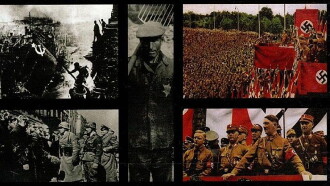
Using exclusively archival footage, Erwin Leiser traces the rise and collapse of the Third Reich, from Adolf Hitler’s early years to the devastation of Europe and his suicide in 1945.
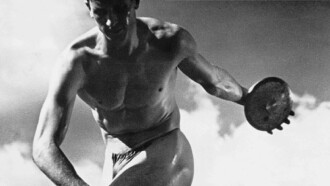
Starting with a long and lyrical overture, evoking the origins of the Olympic Games in ancient Greece, Riefenstahl covers twenty-one athletic events in the first half of this two-part love letter to the human body and spirit, culminating with the marathon, where Jesse Owens became the first track and field athlete to win four gold medals in a single Olympics.
The intricate history of UFA, a film production company founded in 1917 that has survived the Weimar Republic, the Nazi regime, the Adenauer era and the many and tumultuous events of contemporary Germany, and has always been the epicenter of the German film industry.
A Nazi propaganda film made to promote anti-Semitism among the German people. Newly-shot footage of Jewish neighborhoods in recently-conquered Poland is combined with preexisting film clips and stills to defame the religion and advance Hitler's slurs that its adherents were plotting to undermine European civilization.
The SS chief Heinrich Himmler wanted to exchange Jews against so-called German Reich abroad, against arms sales or for cash - with the express approval of Hitler.
Popular movie trailers from 1978
These some of the most viewed trailers for movies released in 1978:
Fifteen years after murdering his sister on Halloween Night 1963, Michael Myers escapes from a mental hospital and returns to the small town of Haddonfield, Illinois to kill again.
In the autobiographical tradition of the earlier Sincerities, this film takes up the light-threads of our living 14 years ago when the Brakhage family found home and "settled," like they say, into some sense of permanence.
A decade and a half ago, poet Robert Kelly told me that the "crucial work" of our time might be what he calls "the dream work": I hope, with this Series, to have entertained his challenge more thoughtfully than with any previous "dream" filmmaking.
The Black Contribution – Literature and Theater 1978 is a rare documentary highlighting the voices and cultural impact of African American writers and performers during the civil rights era.