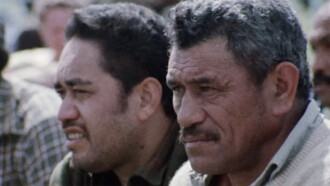
Starting with a scene of a refugee camp in Israeli-occupied Gaza in 1976, the film features shots of various districts, dispensing with narration and interspersing interviews with Palestinian people and fedayeen (guerrillas) in the rubble of Western Beirut. Children who lost their parents in bombings are educated to be soldiers at their orphanage. They say that they want to be soldiers or heroes. Boys and girls sing: "We don't want money. We don't want to play. We will carry guns and enter the Revolutionary Army." Two years after the filming began, the girls have grown but they have not changed their minds.
When a dedicated jockey finds that the local politicians are not to be trusted and begins to feel his romance with a beautiful woman slowly slipping away, his last-ditch effort to risk it all for his trusted horse Palomo shows that sometimes animals are truly man's best friend.
This official entry to the first Metro Manila Film Festival in 1983 directed by Lino Brocka and starred Carmi Martin, Phillip Salvador, Dennis Roldan, Vic Diaz, and Tony Santos, Sr centers on the story of Gigi, a burlesque dancer who is the main attraction of show.
Faithful adaptation of a story by Tomasi di Lampedusa on the encounter between a man and a mermaid, for the television series Ten Italian directors, ten Italian short stories , in which Gianni Amelio, Luigi Comencini, Carlo Lizzani participated among others.
The story, told partly in flashback to 1968, concerns a clique of English public schoolboys who bully and humiliate an unpopular younger pupil (Cox) who is 'bad at games'.
Mary Ocky, a beautiful girl from Mondonedo, Ohio, comes to seek the help of the famous PI Philip Marlboro in order to find her boyfriend Macho Jim who went missing three months earlier under obscure circumstances.
The film is inspired by the Mário de Sá-Carneiro short story, where the narration is made by Professor Antena's assistant who walks by his side when he is run over in a perhaps enigmatic way.