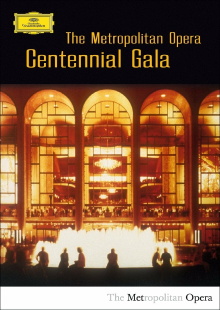
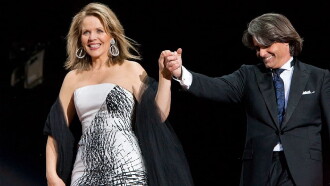
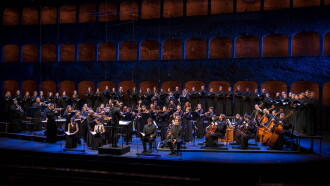
In celebration of its 100th anniversary in 1983, the Metropolitan Opera hosts a four-hour performance uniting some of the world's most spellbinding opera singers and conductors. The event includes a ballet from Samson et Dalila and boasts incredible classical performances from Kathleen Battle, Plácido Domingo, Jose Carerras, Leonard Bernstein, Marilyn Horne, Leona Mitchell, Luciano Pavarotti and many more.
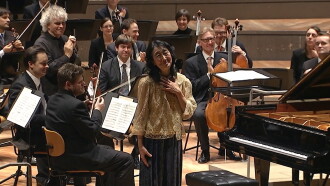
The evocative music of Claude Debussy has been described as the foundation of modern music. But how did the composer come to develop his unique style? On this video, maestro Francois-Xavier Roth and the London Symphony Orchestra present the UK premiere of a previously lost work by the young Debussy, alongside some of his earliest inspirations.
There are only a couple of DVD recordings of Mozart's Symphony No. 40. Fortunately, this one by Karl Bohm, recorded live in Vienna's Musikvereinssaal, is excellent, as are the other Mozart symphonies on this DVD.
Leonard Bernstein made these recordings during his wonderfully productive collaboration with the Wiener Philharmoniker in the mid-1970s when he was at the peak of his career.
There is hardly a better way to approach Ludwig van Beethoven than through his piano concertos. Beethoven’s own instrument was the piano, and in his improvisations – which made him the darling of the Viennese salons – he merged virtuosity and unbridled expression.
Mozart’s Requiem – his final and unfinished masterpiece – is an extraordinary work. Discover the piece at the Salzburg Festival in the hands of conductor Teodor Currentzis, the ensemble musicAeterna, Anna Prohaska (soprano), Katharina Magiera (contralto), Mauro Peter (tenor), and Tareq Nazmi (bass).
This is one of the most important recordings of the 20th century, both for its content (considered by many the greatest cello music of all time) and for the intense devotion, careful preparation, and towering technical skill that went into the project.
Almost any recording of a Mozart symphony by Austrian conductor Karl Bohm (1894-1981) is a sure thing: excellent sound, and sensible, solid, non-sentimental interpretation.
Like many of John Adams’ operas, Doctor Atomic is based on recent world historical events—here, the effusive Robert Oppenheimer, “father of the atomic bomb,” anxiously awaits the bomb’s first test in Los Alamos, New Mexico.
The story, told partly in flashback to 1968, concerns a clique of English public schoolboys who bully and humiliate an unpopular younger pupil (Cox) who is 'bad at games'.
High school student David Lightman has a talent for hacking. But while trying to hack into a computer system to play unreleased video games, he unwittingly taps into the Department of Defense's war computer and initiates a confrontation of global proportions.