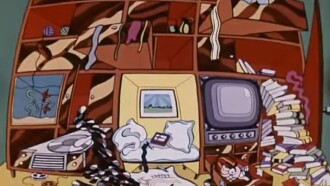
A man kills a toy designer and steals his latest product. The product, a mini-army complete with weapons, then wages war on the killer.
The first Ukrainian screen adaptation of Stephen King's story.
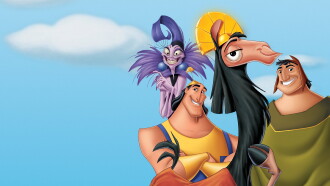
When the self‑absorbed Emperor Kuzco is accidentally transformed into a llama, he must rely on a humble villager to survive the jungle and reclaim his throne.
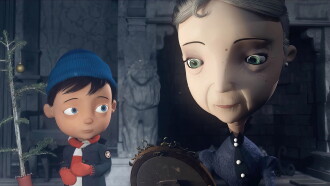
The Lost Letter tells the tale of a young boy as he prepares his neighbourhood for Christmas. That is until he confronts the one lady who doesn't want the holiday to come at all.
"All sounds travel in waves much the same as ripples in water." Educational film produced by Bray Studios New York, which was the dominant animation studio based in the United States in the years surrounding World War I.
Which image is real - the one staring at us from the mirror or the one standing in front of it? In hallways filled with illusions, a simulacrum behind the looking glass, he is trying to find out if he is looking at a stranger or a hidden part of himself.
A short animation by Makoto Shinkai in Lightwave 3D. Inspired by Haruki Murakami's book "Hard-Boiled Wonderland and the End of the World" with music by Tenmon.
THE VISIT is an intimate stop-motion short film about a young girl’s growing-up years and her relationship with her incarcerated father.
Alternative movies trailers for Battle
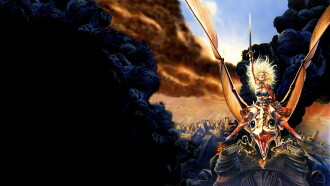
More movie trailers, teasers, and clips from Battle:
Stephen King's Battleground (Сражение) Srazhenie - Soviet Ukrainian Animation
This is an animated short from USSR Ukraine studio Kievnauchfilm. Titled Srazhenie (The Battle) it is based on Stephen King's short story Battleground.
Popular movie trailers from 1986
These some of the most viewed trailers for movies released in 1986:
When Lucy Honeychurch and chaperon Charlotte Bartlett find themselves in Florence with rooms without views, fellow guests Mr Emerson and son George step in to remedy the situation.
The discovery of a severed human ear found in a field leads a young man on an investigation related to a beautiful, mysterious nightclub singer and a group of psychopathic criminals who have kidnapped her child.
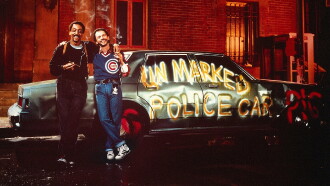
Two street-wise Chicago cops have to shake off some rust after returning from a Key West vacation to pursue a drug dealer that nearly killed them in the past.
A film portrait that falls somewhere between a painting and a prose poem, a look at a woman’s daily routines and thoughts via an exploration of her as a “character”.
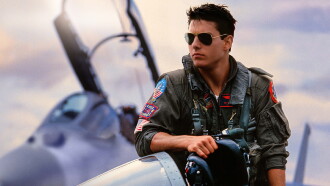
For Lieutenant Pete 'Maverick' Mitchell and his friend and co-pilot Nick 'Goose' Bradshaw, being accepted into an elite training school for fighter pilots is a dream come true.