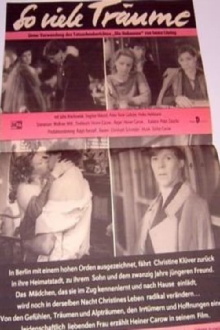
Karin, a well-known and loved midwife in her early forties, receives a high-order decoration from the state. While still overwhelmed with happiness about this honor, she is faced with a difficult decision when she encounters a young women who claims to be her daughter.
Georgia Benfield, at her wit's end, loses control and begins physically abusing her elderly mother, just as Georgia had been abused herself as a child.
Jessica's promising debut as a young artist is shattered by a sudden and violent death. She escapes into a restless succession of journeys whose encounters along the way bring humour, some comfort, but also danger.
In this film, Humbert is on the trail of his own history. Wolfsgrub is the name of the house where Humbert's mother lives, and though she is getting on in years, she becomes young again as she answers her son's questions.
What are Ilona Herfurt and her boyfriend Dietmar Freistrath doing in the old mine? Where does the money come from that her son Jimmy finds under the newspaper? Where have the unique and intricately carved works of art, often passed down for generations, disappeared to from the village in the Ore Mountains? What do the carver Gerlach and his foster daughter llona have to do with it? Questions upon questions that are burning under the detective's nails.
Beate Klarsfeld, a German Protestant housewife, who, with the help of her Jewish law-student husband, Serge, begins an unrelenting campaign after World War II to bring Nazi war criminals to justice.
This film deals with the contrasts of the Wilhelminian era in Berlin: the splendor of the monarchy, the economic and intellectual vitality of the up-and-coming imperial capital on the one hand, and the misery of the proletarians in the tenements on the other.
In this daring follow-up to The History of White People in America, comedian Martin Mull takes us on an in-depth look at such topics as White Religion, White Stress, White Politics, and White Crime.