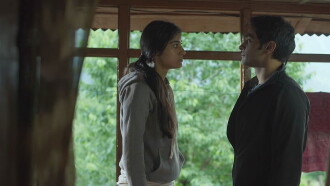
An archeologist sets up a trap with a scorpion, then calls up a fellow worker and pretends he is in great danger. Before dying, he has to know the truth about a certain affair.
The Spanish journalist Manuel Chaves Nogales (1897-1944) was always there where the news broke out: in the fratricidal Spain of 1936, in Bolshevik Russia, in Fascist Italy, in Nazi Germany, in occupied Paris or in the bombed London of World War II; because his job was to walk, see and tell stories, and thus fight against tyrants, at a time when it was necessary to take sides in order not to be left alone; but he, a man of integrity to the bitter end, never did so.
Little Ruben is convinced that Lilith, the mesmerizing woman in their town, is an “aswang.” His life takes a dark turn as her increasingly strange fascination with his family begins to unravel everything he thought he knew.
Palimpsest charts the changing lives of the interior of one house over a period of three centuries, a time-frame compressed into ten minutes - portrayed through a combination of time -lapse, real-time, and stop-frame photography.
Cutting himself off from the world, his friends and especially his father, against whom he nourishes feelings of bitterness, resentment and distrust, Thomas, a 12-year-old boy, becomes increasingly and mysteriously obsessed with swimming and diving in the local swimming pool.
Mars, 2035. The daily wearout overtires the space’s station crew. The anger of one of the members arises, there is no other choice but to conceal it, in order to preserve the apparently cohesiveness of the team.
It's the most exciting moment of the year: Easter night and little Mimosa birthday. Muskotti, her mother, has such a bad memory that she doesn't know how old Mimosa is.
Andy’s friends confront both their own mortality and the deadly new disease stalking their community, while his conservative family grapples with never having come to terms with his sexuality.
This is the story of Lenell Geter, an engineer who was accused and convicted of armed robbery. Because he had such faith in the system, he thought that he would eventually be released.
Comments
Have you watched Le scorpion yet? What did you think about it?