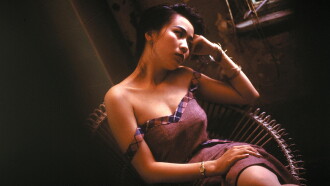
In this interview Müller and Kluge explore the East German’s memories of the final days of the war. The session is introduced by a clip from the Russian film maker Sergei Parajanov’s 1961 film entitled The Ukranian Rhapsody. Here a soldier of the Red Army is writing a letter to his fiancee Oskana on the home front, describing to her his imagined vision of listening to Beethoven’s Moonlight Sonata in the middle of battle. “In the past I rarely listened to Beethoven,” he says, “if he had composed only the Moonlight Sonata, the war would have had to stop in front of it too.” The scene then is interrupted by the arrival of German tanks.
Lakshya finds a bottle, which has Gangaram trapped in it who is his lookalike. He promises to make everything possible with the sand in the bottle, but once the sand is over he will be free to go.
Ref'at is a judge who is ruling on an important case that witnesses a lot of security interference. Rafiq Al-Henawy has him killed and stages it as a suicide before the ruling.
As he gradually turns mad, the dancer Nijinsky evokes the important episodes of his life. In costumes and sets of lush beauty, the divine puppet performs in a final show where the secondary characters are named: Diaghilev, Isadora Duncan, Stravinsky, Auguste Rodin, Léon Bakst.
Vivian is a carefree, streetwise diamond in the rough when she meets sophisticated billionaire Edward in a chance encounter that turns into a week-long business arrangement.
Three part anthology with stories involving a Phantom of the Opera-style killer haunting a theater, four punks who pick the wrong house to rob and a man on the hunt for Bigfoot.
In the midst of trying to legitimize his business dealings in 1979 New York and Italy, aging mafia don, Michael Corleone seeks forgiveness for his sins while taking a young protege under his wing.
Comments
Have you watched Some Kind of Shadow Machines Were Passing by yet? What did you think about it?