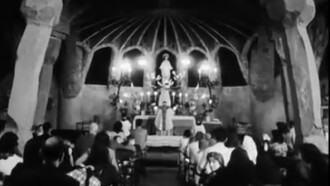
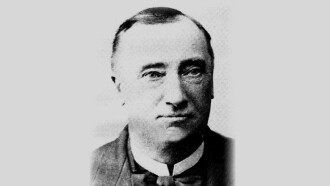
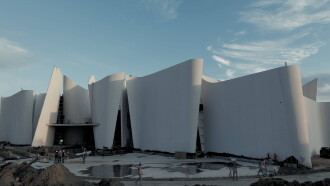
In The Nature of Space, Frank Scheffer juxtaposes the ideas of two Dutch architects: the Benedictine monk Dom H. van der Laan and the anthroposophic architect Ton Alberts. Van der Laan represents a plain and pure architecture, based on his own research into ratios. He designed churches and monasteries, among them a monastery in Vaals. Ton Alberts works from organic forms, as demonstrated by his design of the NMB Bank headquarters in Amsterdam. Director Frank Scheffer stresses the difference in style between these architects, both of whom allow their spiritual background to be reflected in their work, by adopting a very different camera style in the case of each. (filmcommission.nl)
Dan Cruickshank explores one of Britain’s last Victorian country homes, Tyntesfield, a Gothic fantasy frozen in time and a monument to the Victorian age.
Arata Isozaki: Early Work in Japan takes a detailed look at the architect's pieces, exploring applauded projects such as the EXPO '70 Osaka Festival Plaza, Gunma Prefectural Museum of Modern Art and Kitakyushu Municipal Library.
Chambord, the most impressive castle in the Loire Valley, in France, a truly Renaissance treasure, has always been an enigma to generations of historians.
A film essay contrasting the modern metropolis with its "golden age" from 1830-1930, with the participation of some of New York's leading political and cultural figures.
Founded in 1919 by Walter Gropius, Bauhaus was supposed to unite sculpture, painting, design and architecture into a single combined constructive discipline.
This film is a portrait of unique cultural space for Spirits, Gods and People. While permanent theatres are commonly built in most cosmopolitan modern cities, Hong Kong preserves a unique theatrical architecture, a Chinese tradition that has lasted more than a century - Bamboo Theatre.
Billy and Jack are modern-day Robin Hoods who engage in petty scums to earn money for the upkeep of a daycare center for indigent and underprivileged children.
A blind female assassin lives alone in a remote house; her superiors occasionally send her "clients" / targets that she shoots right after having sex with them in her completely darkened bedroom.
A world of the future where society is addicted to the drug of television. Supervision sessions create a perfect illusion of reality, making it almost impossible to return to reality.
A cynical TV weatherman, along with his idealistic producer and his sardonic cameraman, is sent to report on Groundhog Day in the small town of Punxsutawney, where he finds himself repeating the same day over and over.
An interesting attempt at a postmodern crazy comedy with elements of parody. The plot turns on the search for the recipe of a liqueur made by the film’s financial backer.
As part of the film's promotion, a mockumentary was aired on HBO. Titled Hearts of Hot Shots! Part Deux—A Filmmaker's Apology, the mockumentary parodied Hearts of Darkness: A Filmmaker's Apocalypse, the 1991 documentary about the making of the film Apocalypse Now (which starred Charlie Sheen's father, Martin Sheen).
Based on the real life story of Myrna Diones, a 14 year-old survivor of a brutal massacre of her, her sister and their two cousins in the Cordillera mountain range in northern Luzon by the very people who should've protect them, policemen .
Set in the Bronx during the tumultuous 1960s, an adolescent boy is torn between his honest, working-class father and a violent yet charismatic crime boss.
Comments
Have you watched The Nature of Space yet? What did you think about it?