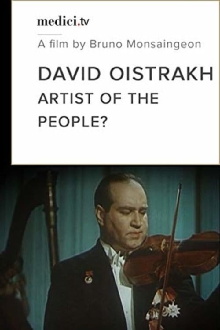
The life and virtuosic work of Russian violinist David Oistrakh, once known as King David in the Soviet Union, is chronicled with depth and detail by filmmaker Bruno Monsaingeon in this intriguing portrait of an artist. Highlights include a range of performance footage throughout Oistrakh's legendary career, as well as interviews with his son, Igor, conductor Gennadi Rozhdestvensky, cellist Mstislav Rostropovich and violinist Yehudi Menuhin.
Director Mohsen Makhmalbaf claims to have never seen a movie before making his first film. Doubtful as it sounds, this boast matches perfectly with the controversial artist's personae.
BEAUTIFUL FUNERALS is a hand-painted double-step-printed film composed of 1) dense blackness variously punctuated by brilliantly colored jewel/flower-like shapes AND 2) interruptive white sections which are fuzzily dotted with blurred whites and criss-crossed by black "brushstrokes" and hard-edge straight black and white lines.
A fleet of Martian spacecraft surrounds the world's major cities and all of humanity waits to see if the extraterrestrial visitors have, as they claim, "come in peace.
A young man makes ends meet by selling camotes in his small providence town, has zero luck getting with the ladies, and is too broke to afford the hookers of the town.
Set on May 18, 1993—the day on which Denmark voted to join the European Union, just a few months after they'd voted not to do so—the film follows eight or so disparate Danes (an escaped mental patient, a newly-famous singer, a business executive, and their assorted families and cohorts) as they unwittingly alter one another's lives, for better and for worse.
When vengeful General Francis X. Hummel seizes control of Alcatraz Island and threatens to launch missiles loaded with deadly chemical weapons into San Francisco, only a young FBI chemical weapons expert and notorious Federal prisoner have the skills to penetrate the impregnable island fortress and take him down.