LOOKING FOR MUSHROOMS (1959-1967) is a psychedelic travelogue film that documents a series of “trips” through rural Mexico and urban America. Conner combined street views of San Francisco shot in the late 1950s with scenes of rural Oaxaca captured during his “mushroom-hunting” excursions between 1961 and 1962, when Bruce and his wife, Jean, were living in Mexico City. On at least one of these trips, the Conners were joined by Timothy Leary, the ex-Harvard professor and soon-to-be leading proponent of psychedelic drugs. In 1996, Conner revised the film once again: he used an optical printer to expand its length from three to fourteen-and-a-half-minutes, and added a new soundtrack, Terry Riley's "Poppy Nogood and the Phantom Band," to create a more meditative, but no less hypnotizing, iteration of the mushroom hunt.
In England banger racing isn't just a sport, but a way of life. This film follows 11 year olds Finn and Harley through a cold winter race day in Birmingham.
Rare 1977 documentary short hosted by Christopher Lee on the occult. Topics range from witch covens, Astrology, psychic powers, seances and astral projection, amongst others.
A middle-aged couple has a drifter enter their lives. The fish-store owners find that the mysterious young man awakens the couple in ways they didn't expect.
With their freedom on the line, the Looney Tunes seek the help of NBA superstar Michael Jordan to win a basketball game against a team of moronic aliens.
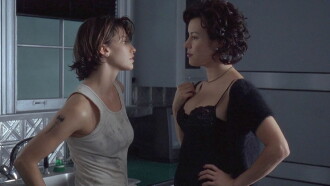
Corky, a tough female ex-convict working on an apartment renovation in a Chicago building, meets a couple living next door, Caesar, a paranoid mobster, and Violet, his seductive girlfriend, who is immediately attracted to her.
The dynamic PR-agent Hannah is starting up her dream-job in the Hochstedt Company producing toys and soon falls in love with her firm's junior executive director, Wolfgang.