This film follows the aftermath of the Oka crisis, which brought Indigenous rights into sharp focus. After the barricades came down, the Royal Commission on Aboriginal Peoples was created, and travelled to more than 100 communities and heard from more than 1,000 representatives. For two-and-a-half years, teams of Indigenous filmmakers followed the Commission on its journey.
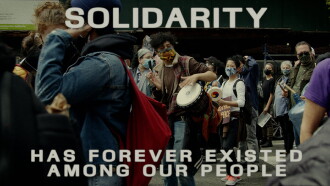
In the face of AAPI violence, an intergenerational coalition of Black, Indigenous, Latinx, Asian, People of Color organizers come together to organize a march across historic Washington Heights and Harlem, as a continuation of the historic and radical Black and Asian solidarity tradition.
In July 1990, a dispute over a proposed golf course to be built on Kanien’kéhaka (Mohawk) lands in Oka, Quebec, sets the stage for a historic confrontation that would grab international headlines and sear itself into the Canadian consciousness.
The Australian Aborigines (in this film anyway) believe that this is the place where the green ants go to dream, and that if their dreams are disturbed, it will bring down disaster on us all.
In the early 1960s the Canadian government conducted an experiment in social engineering. Three young Inuit boys were separated from their families in the Arctic and were sent to Ottawa, the nation's capital, to live with white families and to be educated in white schools.
A documentary account by award-winning filmmaker John Ferry of the events that led up to the 1969 Native American occupation of Alcatraz Island as told by principal organizer, Adam Fortunate Eagle.
Mauri (life principle, life force, vital essence inherent in all living things) The film is an intimate, visually stunning testament to a land and a people who have survived removal, exploitation and colonization — and to the healing ways that are part of the Māori ancestral knowledge.
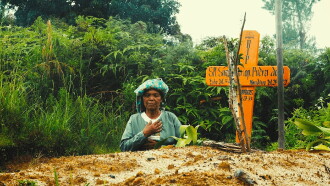
Ompung Putra Boru, a sixties indigenous Batak woman from Humbang Hasundutan, North Sumatra, retraces her life stories through photographs that interweave her past and present as a wife, mother, healer and indigenous land defender in two neighboring villages.
A Sámi woman fights for her right to claim a tax deduction against the purchase of a dog. Why the Swedish authorities fail to recognize the dog's use as a reindeer herding tool versus a pet opens up a larger discussion about Indigenous rights and economic discrimination in this humorous takedown of the Swedish government's ignorance of Sámi culture.
"Here Where It All Ends" is an experimental, poetic short film that moves between documentary and fiction to address an endangered culture, that of indigenous people in the
Brazil.
Ginger Côté uses the words of Heather Archibald, an activist who grew up in foster care and who died, to honor the memory of the young woman and also to advocate for a change in policies towards First Nations.
Popular movie trailers from 1996
These some of the most viewed trailers for movies released in 1996:
The dynamic PR-agent Hannah is starting up her dream-job in the Hochstedt Company producing toys and soon falls in love with her firm's junior executive director, Wolfgang.
A middle-aged couple has a drifter enter their lives. The fish-store owners find that the mysterious young man awakens the couple in ways they didn't expect.
When Hydro-Québec announced its intention to proceed with the enormous James Bay II hydroelectric project, the 15,000 Cree who live in the region decided to stand up to the giant utility.
A doctor and his wife move to a new city where they plan to start a new life. However, trouble strikes in the form of a police inspector who gets completely obsessed with the doctor's wife.
The true story of a Prussian aristocrat working for German military intelligence during World War II, who, with a group of fellow devout Christians, plotted to assassinate Hitler with a bomb in his briefcase.
When Ashtray moves to South Central L.A. to live with his father (who appears to be the same age he is) and grandmother (who likes to talk tough and smoke reefer), he falls in with his gang-banging cousin Loc Dog, who along with the requisite pistols and Uzi carries a thermo-nuclear warhead for self-defense.