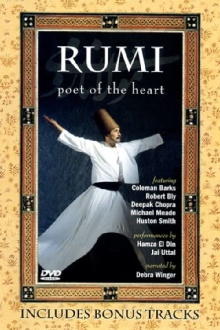
In 1244, Jelaluddin Rumi, a Sufi scholar in Konya, Turkey, met an itinerant dervish, Shams of Tabriz. A powerful friendship ensued. When Shams died, the grieving Rumi gripped a pole in his garden, and turning round it, began reciting imagistic poetry about inner life and love of God. After Rumi's death, his son founded the Mevlevi Sufi order, the whirling dervishes. Lovers of Rumi's poems comment on their power and meaning, including religious historian Huston Smith, writer Simone Fattal, poet Robery Bly, and Coleman Barks, who reworks literal translations of Rumi into poetic English. Musicians accompany Barks and Bly as they recite their versions of several of Rumi's ecstatic poems.
The story of Muhammad Iqbal, a turn of the century poet/philosopher from South Asia. Through Iqbal's work we open a dialog between the East and West, refute the notion of a class of civilizations and discover our shared humanity.
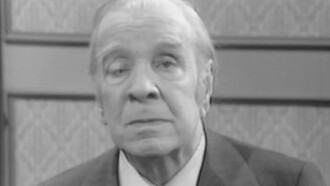
A fragmented biography, inconclusive, partial, of the brilliant Argentinian writer Jorge Luis Borges, based on different testimonies: his links with Leonor de Acedevo —his mother— and María Kodama —his second wife—; his vast culture and devout dedication to literature, his and that of others; his country: the politicians and the disloyal military.
Pablo Neruda’s life unfolds and becomes the basis for the symbolic representation of his poem “Barcarola”, intermixing live action, still footage, computer images, dance and poetry.
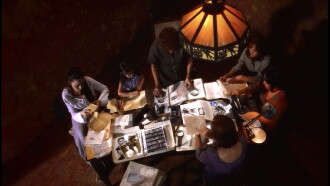
The first episode in a series of “adaptations” of poet Bernadette Mayer’s book Utopia that artist Beatrice Gibson envisions to undertake over the next decade, producing a series of small, quotidian films that together, and over time, will constitute an epic.
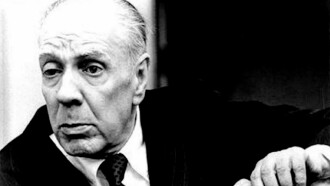
A dramatized approach to the Argentinian writer Jorge Luis Borges (1899-1986) through the recreation of some of his works and the staging of various aspects of his thought and his life.
This film is dedicated to Mas-Félipe Delavouët, the poet discovered by Lawrence Durrell, who wrote 14,000 verses in Provençal over a period of thirty years, and who died on November 18, 1990.
Popular movie trailers from 1998
These some of the most viewed trailers for movies released in 1998:
In a picture-perfect seaside town, an insurance salesman begins to realize that his entire existence may be staged and observed by a vast unseen audience as part of a long-running real-time reality TV show.
A seven-mile-wide space rock is hurtling toward Earth, threatening to obliterate the planet. Now, it's up to the president of the United States to save the world.
In the South Pacific, in Polynesia, on the island of Makatea, Quinn Harris, a taciturn pilot, leads a quiet life, content to earn a living by transporting goods in his De Havilland Beaver.
With personal crises and age weighing in on them, LAPD officers Riggs and Murtaugh must contend with a deadly Chinese crime lord trying to get his brother out of prison.
Bill Parrish has it all - success, wealth and power. Days before his 65th birthday, he receives a visit from a mysterious stranger, Joe Black, who soon reveals himself as Death.
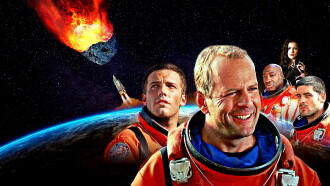
When an asteroid threatens to collide with Earth, NASA honcho Dan Truman determines the only way to stop it is to drill into its surface and detonate a nuclear bomb.