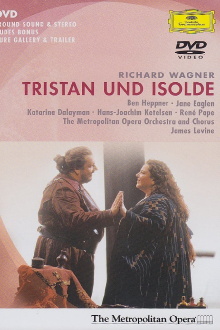
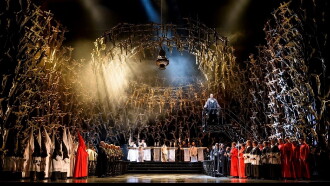
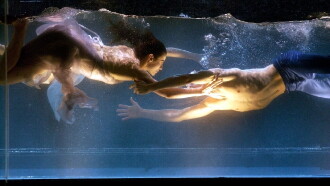
Inspired by Wagner’s own tortured affair with the wife of his patron, this searing masterwork is based on Arthurian legend and tells of an illicit romance between a Breton nobleman and the Irish princess betrothed to his uncle and king. The composer’s larger-than-life sensibilities are on full display throughout the score: Along with intoxicating orchestral music that surges in tandem with the couple’s burgeoning passion and a chord left symbolically unresolved until the last moments of the opera, the opera also features one of the repertory’s most soaring and ecstatic final climaxes, as Isolde surrenders to a love so powerful that she transcends life itself.
Ghiaurov, Freni, and Bumbry were great voices in their time, and they are still effective here -- good enough musicians to put over the quite heavy vocal and expressive demands of their roles.
Wagner's tale of the struggle between spiritual and profane love, and of redemption through love, is given a radical visual update in Sebastian Baumgarten's controversial yet thought-provoking Bayreuth production.
It truly is an historic performance. Domingo looking and singing like a god pouring out golden tones; Renato Bruson sounds, like the sublime Verdian Baritone that he was at that time; Nicolai Ghiaurov proves again that he was one of the greatest "Verdi Basses"; Mirella Freni shows that there was more to her than just being Mimi and Susannah-in fact I can remember reading that at the time of the premiere of this production that there were fist fights (not unusual in La Scala's gallery) between Mirella's many fans--between those fans that just wanting her to continue singing the light lyric repertoire that they were use to her singing and those that felt she should and could sing the lyric-spinto repertoire which, of course, she proved that,indeed, she could (She's still singing more than twenty years later).
Non-musical account of Puccini's opera: Tosca and Cavaradossi are in love, but the tyrant Scarpia desires Tosca and oppresses Cavaradossi who is fighting for freedom.
From the Styriarte Festival in Graz Austria, the acclaimed mezzo-soprano Cecilia Bartoli and Maestro Nikolaus Harnoncourt with his orchestra Concentus Musicu Wien, present a concert on Haydn arias and Symphony No.
In the small town of Rockwell, Maine in October 1957, a giant metal machine befriends a nine-year-old boy and ultimately finds its humanity by unselfishly saving people from their own fears and prejudices.
Two Canadian women return to the Netherlands to recount the terrifying ordeal they experienced as children at the hands of the Nazis, and to connect with the individuals and families who risked their lives to save them.
A film about fate, co-existence, vanity, justice, karma and forgiveness, ANIMALICOUS comprises six stories of people and the animals that shot them, fell on them, and generally caused mayhem of one sort or another.
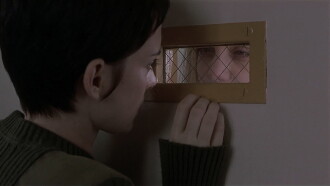
Set in the changing world of the late 1960s, Susanna Kaysen's prescribed "short rest" from a psychiatrist she had met only once becomes a strange, unknown journey into Alice's Wonderland, where she struggles with the thin line between normal and crazy.
Why do women fight? This riveting behind-the-scenes look into the world of the female combatant takes us from manicures to knockouts! It turns our attention to the woman who is widely considered pound for pound the most dangerous fighter of any time, undefeated boxing sensation Lucia Rijker (Rollerball, TV's "Thunderbox").