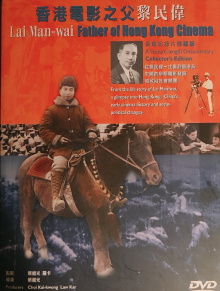
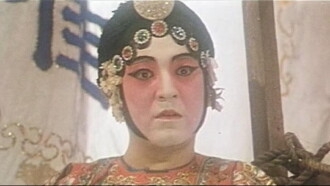
In the life of Mr. Lai Man-wai, he had seen the most turbulent times of recent Chinese history. From the fall of the Qing Dynasty to the founding of the Republic, from the Sino-Japanese War to the founding of the People’s Republic. With a patriotic spirit, he joined the revolution and used the theatre to promote the revolutionary course. For a ‘stronger China’, and ‘education for all’, he chose film as his life long goal and career. Lai was more than the father of Hong Kong cinema was; he was also one of the pioneers of the Chinese cinema. He made Hong Kong’s first short fiction film ‘Zhuangzi Tests His Wife’. He opened the first Chinese owned cinema, the New World Cinema, in Hong Kong…. In the several decades, Lai had devoted his life and fortune in writing this glorious inaugural chapter in early Chinese film history. The technical enhancement, the introduction of foreign techniques and equipment were all part of his contribution to the Chinese cinema.
Filmmaker Ian Taylor examines the impressive legacy of Hong Kong cinema -- specifically, how martial arts crossed borders and become an international phenomenon -- with the help of footage and interviews with the stars who made the genre what it is today.
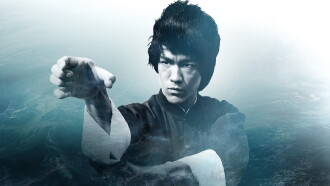
The fantastic story of how an ancient martial art, Chinese kung fu, conquered the world through the hundreds of films that were produced in Hong Kong over the decades, transformed Western action cinema and inspired the birth of cultural movements such as blaxploitation, hip hop music, parkour and Wakaliwood cinema.
Tells the story of how Edward Snowden managed to evade capture by the US. For the first time Snowden tells the story of how he managed to escape so that not to have to spend the rest of his life in an American prison.
This anthology film, whose Chinese title begins with a romantic name for human excrement, premiered internationally at Rotterdam and won Best Screenplay from the Hong Kong Film Critics Society.
An exploration of Chinese cinema and its relationships with gender and sexuality, which the film argues has been more frankly and provocatively explored than in any other national cinema.
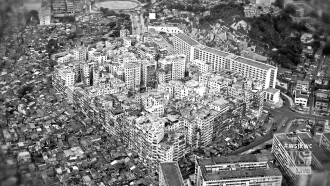
Allows glimpses on a Hong Kong shortly before the 1997 handover to China. But rather than focusing on the expected hysteria Luc Schaedler’s documentary debut works towards complexity by allowing six diverse residents to talk about their relationship to the colonial city.
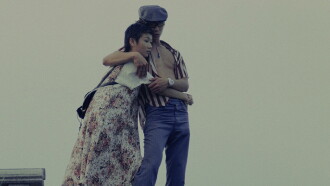
On the day a young photographer is moving out of his place to live with his girlfriend, he meets the stunning girl moving in and falls in love with her at first sight.
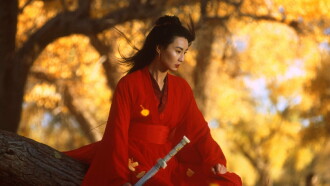
During China's Warring States period, a district prefect arrives at the palace of Qin Shi Huang, claiming to have killed the three assassins who had made an attempt on the king's life three years ago.
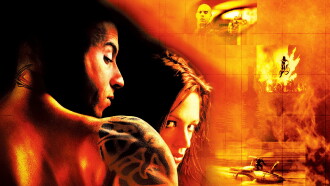
Xander Cage is your standard adrenaline junkie with no fear and a lousy attitude. When the US Government "recruits" him to go on a mission, he's not exactly thrilled.
A player in a famous orchestra finds sexual experiences with a Russian opera singer, which he enjoys much because his wife has just left due to the fact that he has purchased a porno movie.
Selling the world from the trunk of his worn and dented 1948 Tucker, James Frederickson travels across the American countryside with nothing but a car full of altlases and a sales pitch.
A man signs up as a driver for a group of criminals on a dangerous job. On the way to the hit the man hears the lottery numbers and realises he's got the winning ticket on him.
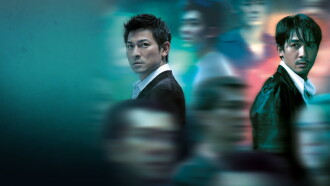
Chan Wing Yan, a young police officer, has been sent undercover as a mole in the local mafia. Lau Kin Ming, a young mafia member, infiltrates the police force.
Comments
Have you watched Lai Man-wai: Father of Hong Kong Cinema yet? What did you think about it?