"A Woman of Paris" (1923) was the first film Chaplin made for United Artists Film Corporation, which he founded with his friends Mary Pickford, Douglas Fairbanks and D. W. Griffith. Chaplin had long considered making a dramatic feature. For the first time, he decided to direct. Actress and filmmaker Liv Ullmann analyses the film. She talks about the acting, the originality of the characterizations, as well as the "feminine" viewpoint Chaplin adopted for the first time in his films.
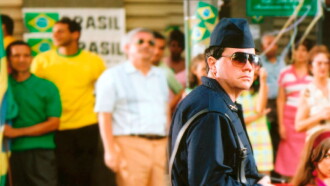
A satire about the dictatorship period in Brazil, in which communist militants try to steal the soccer World Cup Trophy from the players Pelé and Carlos Alberto Torres.
As armies mass for a final battle that will decide the fate of the world--and powerful, ancient forces of Light and Dark compete to determine the outcome--one member of the Fellowship of the Ring is revealed as the noble heir to the throne of the Kings of Men.
Bruce Nolan toils as a "human interest" television reporter in Buffalo, NY, but despite his high ratings and the love of his beautiful girlfriend, Bruce remains unfulfilled.
From the front-lines of conflicts in Mexico, Argentina, South Africa, Palestine, Korea, 'the North' from Seattle to Genova, and the 'War on Terror' in New York, Afghanistan, and Iraq.
When Travis, the mouthy son of a criminal, disappears in the Amazon in search of a treasured artifact, his father sends in Beck, who becomes Travis's rival for the affections of Mariana, a mysterious Brazilian woman.
Off the coast of the volcanic island of Santorini, the intrepid archaeologist Lara Croft makes the unexpected discovery of a pulsating golden orb able to guide its holder to the mythical Pandora's Box.
When an impulsive boy named Kenai is magically transformed into a bear, he must literally walk in another's footsteps until he learns some valuable life lessons.
Comments
Have you watched Chaplin Today: A Woman of Paris yet? What did you think about it?