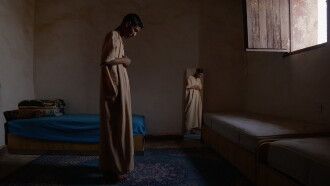
Ali Salem Hamudi Mohamed - Yahdih, was born in 1955 in El Aaiún (Western Sahara). He completed his secondary schooling in the "Spanish" Sahara. A scholarship allowed him to enrol at the Universidad de la Peninsula in 1975, but Morocco's invasion of the Sahara led him to return to the city of his birth and go into exile with his people, participating in the resistance and helping to organise the Tindouf Refugee Camps (Algeria). In 1980, the Polisario Front and the Government of Cuba offered him the opportunity to study Architecture at the University of Havana. On his return to the Camps in 1985 he worked for the SADR's Department of Construction. He designed more than twenty public buildings, including town halls, schools and nursery schools, and also collaborated with international aid organisations to build hospitals and training colleges. All of these buildings were built collectively by the Saharan people. ;In 1999 he emigrated to Spain. His family joined him five years later.
At the Munich Olympics of 1972, John Akii Bua, from the impoverished African country of Uganda, powered round the inside lane in the 400m hurdles, past the English favourite, and reigning Olympic Champion David Hemery, to win the gold medal, 10m clear of the field.
Filled with vitality, humor and unexpected situations, Hamada paints an unusual portrait of a group of young friends living in a refugee camp in the middle of nowhere.
Straddling a 2,400-kilometer-long wall constructed by the Moroccan army, the Western Sahara is today divided into two sections — one occupied by Morocco, the other under the control of the Sahrawi National Liberation Movement’s Polisario Front.
During the 1965 mass killings to eliminate the Indonesian Communist Party, the new regime banned scholars in the Soviet Union and China, forcing them into exile across Europe.
We encounter the controversial Croatian film director Lordan Zafranovic in voluntary exile in Prague. The film follows his rise from a talented outsider to the celebrated Yugoslav director of the acclaimed war film, 'An Occupation in 26 Pictures'. His life story is an unconventional depiction of a rise and fall that reveals compromises made in order to survive artistically during communism, as well as the missed opportunities and miscalculations that led to his inability to adapt in later years. Is the charismatic Zafranovic a national traitor or a victim of historical circumstances in which the only thing he wanted to do, in his own words, was to be himself and make films?
The political upheaval in North Africa is responsibility of the Western powers —especially of the United States and France— due to the exercise of a foreign policy based on practical and economic interests instead of ethical and theoretical principles, essential for their international politic strategies, which have generated a great instability that causes chaos and violence, as occurs in Western Sahara, the last African colony according to the UN, a region on the brink of war.
It follows Chilean writer Antonio Skármeta as he celebrates the end of the autocrats. Cheerful farewell rituals accompany others facing political persecution on their way to fly home.
Popular movie trailers from 2008
These some of the most viewed trailers for movies released in 2008:
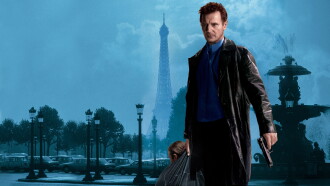
Bryan Mills, a former government operative, is trying to reconnect with his teenage daughter Kim. After reluctantly agreeing with his ex-wife to let Kim go to Paris on vacation with a friend, his worst nightmare comes true.
John Legend: Live from Philadelphia actually constitutes a two-disc set, with an album and a disc of concert footage culled from r&b and neo-soul demigod Legend's Philadelphia engagements on his "Show Me" tour.
Determined to understand the repeating patterns he was finding in nature, French mathematician Benoit Mandelbrot used an early form of computer imagery to produce his own versions, coining the recurring shapes fractals.
When Sosuke, a young boy who lives on a clifftop overlooking the sea, rescues a stranded goldfish named Ponyo, he discovers more than he bargained for.
In this soulful surf documentary, filmmaker Cyrus Sutton shadows five different surfers, capturing the ups and downs of their daily routines -- much like the ebb and flow of the waves they ride with such passion.
Wounded in Africa during World War II, Nazi Col. Claus von Stauffenberg returns to his native Germany and joins the Resistance in a daring plan to create a shadow government and assassinate Adolf Hitler.
When a disc containing memoirs of a former CIA analyst falls into the hands of gym employees, Linda and Chad, they see a chance to make enough money for Linda to have life-changing cosmetic surgery.
A mysterious story set in a run-down house where an eccentric elderly lady lives alone. One day, a little girl steps inside the house and never comes back.
Comments
Have you watched Ali Salem, architect of resistance yet? What did you think about it?