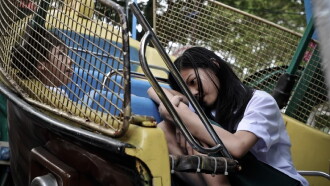
Sakiko is a typical teenager in many ways. She hates her divorced father, who chases after every skirt he sees. She does not know, if she will ever be loved by the other sex. When her dad suddenly inherits a lot of money and becomes really lazy, she hates him even more. He finally decides to start his own cafe, where Sakiko, of course has to help. From this moment, strange customers and good-looking waitresses form the center of tension between father and daughter.
A witty young woman, Samantha Billows, is diagnosed with a bizarre social anxiety disorder. No therapist seems to help her move beyond her plant maintenance job.
A radical hybrid of spy, sci-fi, Western, and even horror genres, Craig Baldwin's Mock Up On Mu cobbles together a feature-length "collage-narrative" based on (mostly) true stories of California's post-War sub-cultures of rocket pioneers, alternative religions, and Beat lifestyles.
Chosen by prophecy but doubted by all, Po is an unlikely choice for the mystical title of the Dragon Warrior—a clumsy panda thrust into the world of kung fu as a deadly enemy threatens the Valley of Peace.
After hundreds of years doing what he was built for, WALL•E— a robot designed to clean up the earth—discovers a new purpose in life when he meets a sleek search robot named EVE.
A beautiful grad student named Tara Simmons is abducted by aliens in a flying saucer. Four days later she finds herself back on earth at the top secret government facility Areola 51, which documents sexual encounters with aliens.
Three small films for as many reflections on the senses and human knowledge. In the first episode, Emmer reviews with anthological and didactic intent the precepts of ancient philosophy, from Greek to Roman civilization; in the second, working as he did at the beginning of his career on a vast repertoire of pictorial and non-pictorial images, he analyzes the “history of the gaze” in the visual arts, from prehistoric graffiti to medieval altarpieces, from Impressionist and Cubist paintings to modern-day advertising posters; finally, in the third, recounting with irony and lightness a day of solitude in his mountain home, he reflects on the intellectual thinking of writers and great thinkers, relating to his own individual experience as much the words of oral tradition and popular culture as the writings of geniuses such as Shakespeare, Spinoza or Gogol.