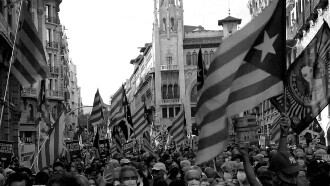
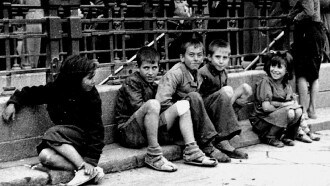
This documentary features the story of Jules Paivio, the last living Canadian volunteer of the infamous Mackenzie-Papineau Battallion of the “International Brigades”. When Jules left from his home near Port Arthur (Thunder Bay), Ontario, his father, a famous Finnish poet, wrote a lasting lament: “To My Son In Spain”. In 1936-37, 1700 Canadians volunteered to fight with the Spanish people against a fascist coup d’etat led by elements of the Spanish Army. Backed by Musselini and Hitler, the fascists were bent on overthrowing Spain’s democratically elected socialist government and replacing it with military and church rule. It could be argued this conflict marked the true beginning of what would become World War II.
Obsessively referring to the traumas and wounds that the Spanish civil war (1936-39) and Franco's dictatorship (1939-75) caused in their day no longer serves to explain the impassable abyss of incomprehension and hatred that the abject policies and radical positions adopted by both the right and the left in recent decades have opened up before the citizens of a country that is barely known beyond hackneyed cultural clichés.
This Traveltalk series short looks at four of Spain's most famous cities, Granada, Seville, Toledo, and Madrid, with an emphasis on the Moors and their influence on the country.
Filmed in Cordoba, Granada, Seville, and Toledo, this documentary retraces the 800-year period in medieval Spain when Muslims, Christians, and Jews forged a common cultural identity that frequently transcended their religious differences, revealing what made this rare and fruitful collaboration possible, and what ultimately tore it apart.
In 1939, just finished the Spanish Civil War, Spanish republican photographer Francesc Boix escapes from Spain; but is captured by the Nazis in 1940 and imprisoned in the Mauthausen concentration camp, in Austria, a year later.
A particular reading of the hard years of famine, repression and censorship after the massacre of the Spanish Civil War (1936-39), through popular culture: songs, newspapers and magazines, movies and newsreels.
A walk through the golden age of Spanish exploitation cinema, from the sixties to the eighties; a low-budget cinema and great popular acceptance that exploited cinematographic fashions: westerns, horror movies, erotic comedies and thrillers about petty criminals.
The adventurous life of Natacha Rambova (1897-1966), an American artist, born Winifred Kimball Shaughnessy, who reincarnated herself countless times: false Russian dancer, silent film actress, scenographer and costume designer, writer, spiritist, Egyptologist, indefatigable traveler, mysterious and curious; an amazing 20th century woman who created the myth of Rudolph Valentino.
Sven has a dream. Once in his life he wants to walk the Camino de Santiago - the Way of St. James. But that seems impossible, Sven has Usher syndrome, a disease which slowly, inexorably robs him of hearing and vision.
In their spare time, after their studies or their work, children and adolescents between the ages of eight and sixteen meet at the School of Bullfighting in Madrid to learn the Art of Cúchares: Torear.
Nikki Blue is a dancer at a strip club hidden along a back road in rural New England. Further down the road, Alice, a burnt-out, neurotic college grad with no particular ambitions, spends her days working at a roadside fossil and rock shop.
In Nazi-occupied France during World War II, a group of Jewish-American soldiers known as "The Basterds" are chosen specifically to spread fear throughout the Third Reich by scalping and brutally killing Nazis.
A teacher opens a time capsule that has been dug up at his son's elementary school; in it are some chilling predictions -- some that have already occurred and others that are about to -- that lead him to believe his family plays a role in the events that are about to unfold.
In this unaired TNT TV pilot, a Charlestown native returns to his hometown from serving in Afghanistan to join the Boston Police force like his father and brother before him.
Comments
Have you watched To My Son in Spain: Finnish Canadians in the Spanish Civil War yet? What did you think about it?