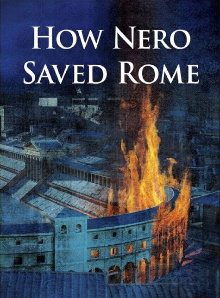
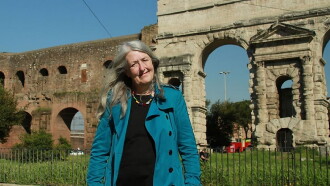
Nero is accused of having "fiddled while Rome burned" and remembered for executing his mother and burning Christians alive. History has sided against him on all counts, but could there be another side to ancient Rome's notorious emperor? National Geographic reveals how Nero rebuilt a city devoured by fire, revolutionizing Western architecture and forever changing the face of Rome.
The capture of Naples, the first great European city to be liberated, revealed the magnitude of the tasks involved in re-creating the means of livelihood and the machinery of government in a devastated, starving and disease-ridden city.
At the time of Nero, the Empire is at the height of its power, but Rome, where a million inhabitants live, is afraid of its enemies, of foreigners, of barbarians.
Newly edited version of Luigi Cozzi's 1997 documentary "Il mondo di Dario Argento 3: Il museo degli orrori di Dario Argento" focusing on the museum-part of the "Profondo Rosso" shop.
The greatest amphitheatre ever built by the Romans and a monument to blood and brutality. But what were the origins of the Colosseum and the gruesome spectacles performed within? With unique access to new archaeology, Colosseum: Rise and Fall explores the true purpose of the Colosseum and the network of amphitheatres spread throughout the Roman Empire.
In a race against time and all odds, the revolutionary F1 racing car Ferrari 312B will get back on the Monaco circuit, 46 years later, under the wing of it’s creator, the genius engineer Mauro Forghieri.
The intimate and passionate portrait of the late Max Croci in a documentary that recalls the human and cultural depth with the testimonies of friends and colleagues.
Originally produced in 1997 on the threshold of the Third Millennium of the Christian Era, and in celebration of the Jubilee of the Year of Our Lord 2000, The Vatican Museums was the culmination of three years of research and filming, the collaboration of thirty-two scholars and historians from around the world, a crew of forty directors of photography, operators, and lighting technicians, state-of-the-art digital cinematography, lighting, animation, and computerized editing, and the work of a famous composer with original performances by master musicians.
Six big north faces of the Alps. The film consists of six films: "Die Wand der Wände" (Eger by Robert Jasper, Roger Schäli), "Das letzte Wort hat der Berg" (Matterhorn by Michael Lerjen, Jorge Ackermann), "Selig, wer in Träumen stirbt" (Grandes Jorasses by Felix Berg, Robert Steiner), "Licht und Schatten" (Piz badile by Hansjörg Auer), "Grenzen der Felskletterei" (Drei Zinnen by Alexander Huber) and "Der zerfallene Berg" (Petit Dru by Steve House, Andy Parkin).
What is true and what is false in the hideous stories spread about the controversial figure of the Roman emperor Gaius Julius Caesar Augustus Germanicus (12-41), nicknamed Caligula? Professor Mary Beard explains what is accurate and what is mythical in the historical accounts that portray him as an unbalanced despot.
Going to the very heart of the Bible's most challenging Book, this one hour documentary decodes the visions of Revelation 12 and 17 for everyone to understand.
Popular movie trailers from 2010
These some of the most viewed trailers for movies released in 2010:
A hotel room in the center of Rome serves as the setting for Alba and Natasha, two sexy and recently acquainted women, to have a physical adventure that touches their very souls.
As the son of a Viking leader on the cusp of manhood, shy Hiccup Horrendous Haddock III faces a rite of passage: he must kill a dragon to prove his warrior mettle.
Harry, Ron and Hermione walk away from their last year at Hogwarts to find and destroy the remaining Horcruxes, putting an end to Voldemort's bid for immortality.
Barney Ross leads a band of highly skilled mercenaries including knife enthusiast Lee Christmas, a martial arts expert Yin Yang, heavy weapons specialist Hale Caesar, demolitionist Toll Road, and a loose-cannon sniper Gunner Jensen.
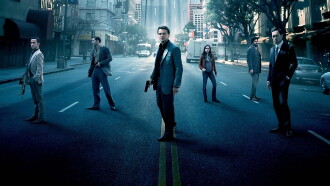
Cobb, a skilled thief who commits corporate espionage by infiltrating the subconscious of his targets is offered a chance to regain his old life as payment for a task considered to be impossible: "inception", the implantation of another person's idea into a target's subconscious.
Comments
Have you watched How Nero Saved Rome yet? What did you think about it?