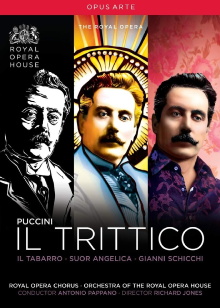
"Puccini's Il Trittico:Il Tabarro, Suor Angelica and Gianni Schicchi - from the Royal Opera 2011 performances"12 September 2011Music180 mins
Il tabarro is a tale of jealousy and murder between Michele, his young wife Giorgetta and her lover Luigi, set aboard a barge on the Seine. Suor Angelica tells the story of the nun Angelica’s familial loss, sacrifice and suicide. Gianni Schicchi is an opera full of trickery, greed and romance as a family dispute breaks out over a missing will. The Olivier-nominated Royal Opera production featuring a trio of one-act Puccini operas was first performed together on the same bill at Covent Garden in September 2011, and was acclaimed by the Telegraph as "an operatic treat... three hours of gorgeous music that allows big voices to let emotion rip" and by the Evening Standard as "a triumphant vindication of the social awareness and dramatic power of Puccini's triptych". The trio of operas offers a panorama of emotions, with the dark and foreboding Il tabarro and comic Gianni Schicchi bookending a heart-wrenching Suor Angelica.
In Rigoletto, the deformed figure of the hunchbacked jester at the Mantuan court acts as a foil to his cynical and powerful master, an unscrupulous philanderer contrasted with his cruel and unforgiving fool.
Opera in three acts, a prologue and an epilogue, by Jacques Offenbach (1819-1880), with a libretto in French by Jules Barbier (1825-1901), based on a work that Barbier himself and Michel Carré (1821-1872) had written based on stories by E.
Can the darkest moments of life also lift our souls? Drawing on his own experience in a Siberian prison in the company of misfits, murderers and theives, Dostoevsky was inspired to write his novel Notes from a Dead House, telling his brother at the time: ‘Believe me, there were among them deep, strong, beautiful natures, and it often gave me great joy to find gold under a rough exterior.
Arabella, Op. 79, is a lyric comedy or opera in three acts by Richard Strauss to a German libretto by Hugo von Hofmannsthal, their sixth and last operatic collaboration.
La traviata (Italian: [la traˈviaːta], "The Fallen Woman"[1][2]) is an opera in three acts by Giuseppe Verdi set to an Italian libretto by Francesco Maria Piave.
In 1935, renowned Portuguese neurologist Egas Moniz visits psychiatrist Sobral Cid, trying to convince him to use his patients as subjects for an experimental treatment: frontal leukotomy.
JJ Justice is a man in transition. A once successful right-wing radio broadcaster, who's lost his edge, his wife and any hope of airing in a real market.
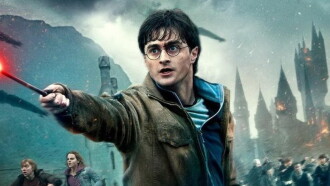
Harry, Ron and Hermione continue their quest to vanquish the evil Voldemort once and for all. Just as things begin to look hopeless for the young wizards, Harry discovers a trio of magical objects that endow him with powers to rival Voldemort's formidable skills.
To win the celebrity and self-made wealth he craves, an aimless, twenty-something Manhattan playboy devises a film based on his party-boy, club-going lifestyle, and hires a self-destructive aspiring playwright to ghost the feature script.
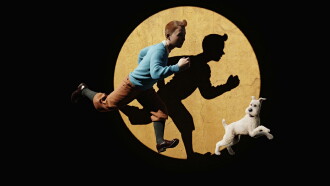
Intrepid young reporter, Tintin, and his loyal dog, Snowy, are thrust into a world of high adventure when they discover a ship carrying an explosive secret.
Aibileen Clark is a middle-aged African-American maid who has spent her life raising white children and has recently lost her only son; Minny Jackson is an African-American maid who has often offended her employers despite her family's struggles with money and her desperate need for jobs; and Eugenia "Skeeter" Phelan is a young white woman who has recently moved back home after graduating college to find out her childhood maid has mysteriously disappeared.
In the not-too-distant future, the aging gene has been switched off. To avoid overpopulation, time has become the currency and the way people pay for luxuries and necessities.