The movie is based on the true story of Takumi Asakawa - a Japanese man who entered Korea during the country's occupation by Japan. Takumi Asakawa became captivated by Korean culture and championed the value of such items as the traditional white Korean porcelain.
1930s Korea, in the period of Japanese occupation, a new girl, Sook-hee, is hired as a handmaiden to a Japanese heiress, Hideko, who lives a secluded life on a large countryside estate with her domineering Uncle Kouzuki.
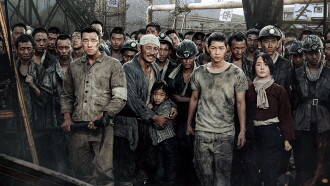
During the Japanese colonial era, roughly 400 Korean people, who were forced onto Battleship Island 'Hashima Island' to mine for coal, attempt to escape.
During the invasion of Normandy the photograph of a slim Korean man in German uniform was found. It transpired that the man had served as a soldier in the Japanese, Russian and German armies.
A man wanders around the mountains with a bleeding leg, holding a rifle in his hand. Seemingly a fugitive, he runs from as-yet unknown pursuers, but he also seems to be following somebody who has already walked the same path.
Pil-ju, an Alzheimer's patient in his 80s, who lost all his family during the Japanese colonial era, and devotes his lifelong revenge before his memories disappear, and a young man in his 20s who helps him.
From the Japanese Occupation a 'comfort woman' returns from China an old woman. At the end of the war she can't return home and spends the next 65 years living as an alien in a foreign country.
Based on the life of the Korean anarchist Park Yeol, the film shows his struggle to counter the massacre of Koreans by the government during the 1923 great Kanto earthquake, focusing on his activities as the leader of the anti-Japanese organization Bulryeongsa and his relationship with Japanese comrade Fumiko Kaneko.
The story is set some time in the past, or maybe some time in the future. Given a time-frame, we would say somewhere between the American moonwalk, and Coca- Cola's serious ambition to turn the moon into an advertising logo.
Follow Jeff, a smart but directionless techie, some would say an "unchallenged" geek, as he falls down a mystic rabbit hole-leaving behind his dead-end job in tech support.
Following the death of District Attorney Harvey Dent, Batman assumes responsibility for Dent's crimes to protect the late attorney's reputation and is subsequently hunted by the Gotham City Police Department.
Comments
Have you watched The Way: Man of the White Porcelain yet? What did you think about it?