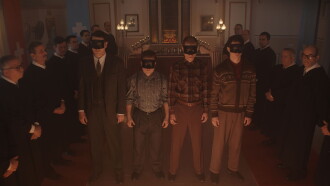
For over 130 years till 1996, more than 100,000 of Canada's First Nations children were legally required to attend government-funded schools run by various Christian faiths. There were 80 of these 'residential schools' across the country. Most children were sent to faraway schools that separated them from their families and traditional land. These children endured brutality, physical hardship, mental degradation, and the complete erasure of their culture. The schools were part of a wider program of assimilation designed to integrate the native population into 'Canadian society.' These schools were established with the express purpose 'To kill the Indian in the child.' Told through their own voices, 'We Were Children' is the shocking true story of two such children: Glen Anaquod and Lyna Hart.
This short impressionist documentary looks at the creation of a Button Blanket by integrating the performance of a traditional dance with the art of the West Coast Heiltsuk Nation.
Documentary about filmmaker Bonnie Ammaaq's memories of life on Baffin Island, where her family moved for eleven years during her childhood from the hamlet of Igloolik to return to the traditional Inuit way of life.
Legendary documentary filmmaker Alanis Obomsawin provides a glimpse of what action-driven decolonization looks like in Norway House, one of Manitoba's largest First Nation communities.
Phil Comeau shines a spotlight on the Ordre de Jacques-Cartier, a powerful secret society that operated from 1926 to 1965, infiltrating every sector of Canadian society and forging the fate of French-language communities.
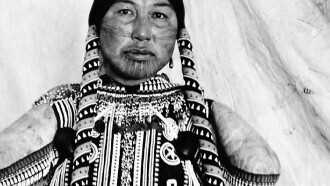
Inuit traditional face tattoos have been forbidden for a century, and almost forgotten. Director Alethea Arnaquq-Baril, together with long-time friend and activist Aaju Peter, is determined to uncover the mystery and meaning behind this beautiful ancient tradition.
This film explores how Canada wavers between rejection and acceptance of closer ties with the United States, tracing the historical precedents of current issues between the two nations.
Yndio do Brasil is a collage of hundreds of Brazilian films and films from other countries - features, newsreels and documentaries - that show how the film industry has seen and heard Brazilian indigenous peoples since they were filmed in 1912 for the first time: idealised and prejudiced, religious and militaristic, cruel and magic.
A polemic against Werner Herzog and the making of "Fitzcarraldo", exploring the question of the filmmaker's ethical and moral responsibility.
Alternative movies trailers for We Were Children
More movie trailers, teasers, and clips from We Were Children:
IDFA 2012 | Trailer | We Were Children
International premiere at IDFA 2012 Adult indigenous people look back on the days when they were forced to ...
When We Were Children Trailer
The Trailer to my upcoming film 'When We Were Children'.
"We Were Children" Trailer
Trailer for the workshop of "We Were Children" first performed at the Hudson Guild Theater in NYC as part the Theater Thespis Festival. Director: Joshua Chase ...
We Were Children
A lot of guns were fired that day.
When We Were Children
The Trailer to my upcoming film 'When We Were Children'.
we were children
A war story. This one happens to be my mother's. Sadly enough that's only a mildly relevant fact. There are millions of stories like hers out Karin Vlietstra ...
Popular movie trailers from 2012
These some of the most viewed trailers for movies released in 2012:
One morning in an ordinary town, five people are shot dead in a seemingly random attack. All evidence points to a single suspect: an ex-military sniper who is quickly brought into custody.
Before Nike, and Adidas, there was the Hi-Jo! Here is a Brooklyn tale set back in the day about a young Italian-American shoemaker (Frank) on the verge of greatness.
For one of the longest-running game franchises in history, Street Fighter creators Capcom needed something exceedingly special to accompany the release of their 25th anniversary edition of the game.