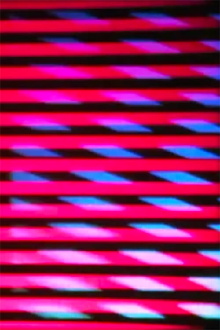
In Second Hermeneutic, the visuals are created by a pair of graphic animated films projected so that they partially overlap, the animated bands and fields of color linked audibly to the soundtrack in an immediately synchronous way – as something appears on screen, there is a directly audible response. This sound emerges from his use of the video camera’s visual output run through his audioboard to the speakers: it is an analogue sonification of the video signal. As a purely audio-visual experience, the performance might seem similar to such early expanded cinema works as Paul Sharits’ Shutter Interface (1975) where a series of four film projectors overlap their frames, creating juxtapositions and combinations on screen – as in Second Hermeneutic; however, the difference is instantly apparent in the performance itself – the soundtrack emerges from the interaction of projected imagery resembling the bands and bars of an optical soundtrack, but with the addition of saturated color.
Surfer Dane Reynolds takes a sharp look into the timeless style of Craig Anderson. A modern approach with hints to the past, Slow Dance follows Craig in and out of the water as he travels the world meeting up with heroes and friends in Australia, Chile, India, West Africa and Tahiti to name a few.
What does it take to say a word of love? How long and how much strength does it take for the heart to speak? How many streets at night? How fast? How many faces in how many bars? What tenderness? What pain? What music? What images in the mind? And where does it come from? Is it in the darkness of a closed park at night? In the back room of a Chinese bar? In the bottom of a beer? In a collective dance? In a sister's laughter? When does it finally happen? For the soul to let go.