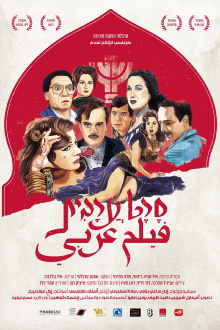
So many Israelis still wax nostalgic about that old Friday afternoon ritual, back in the times when television had just one channel. Everyone would watch the Arab movie of the week, but did anybody ever wonder how Israel’s official TV station was able to transcend hostile boundaries to obtain these films, and why it insisted on showing movies made by “the enemy”? The Arabic-language movie from Egypt let some of us escape back to our original homeland, and let others peek out from our “villa in the jungle” and catch a glimpse of our neighbors across the border. But most of us didn’t really want to see the people whose culture, anguish, and aspirations were reflected on our screens. “Arab Movie” brings us the stars and the songs, the convoluted plots, and that fleeting moment when we shared the same cultural heroes as everyone else in the Middle East. But this film about the richness and intensity of Egyptian cinema also raises some disturbing questions.
Filmed in Cordoba, Granada, Seville, and Toledo, this documentary retraces the 800-year period in medieval Spain when Muslims, Christians, and Jews forged a common cultural identity that frequently transcended their religious differences, revealing what made this rare and fruitful collaboration possible, and what ultimately tore it apart.
Four lives that could not be more different and a single passion that unites them: the unconditional love for their cinemas, somewhere at the end of the world.
An exhaustive explanation of how the military occupation of an invaded territory occurs and its consequences, using as a paradigmatic example the recent history of Israel and the Palestinian territories, the West Bank and the Gaza Strip, from 1967, when the Six-Day War took place, to the present day; an account by filmmaker Avi Mograbi enriched by the testimonies of Israeli army veterans.
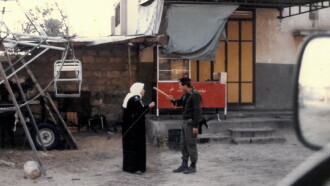
A film director from Israel interviews fellow veterans of the 1982 invasion of Lebanon to reconstruct his own memories of his term of service in that conflict.
Working largely uncredited in the Hollywood system, storyboard artist Harold and film researcher Lillian left an indelible mark on classics by Alfred Hitchcock, Steven Spielberg, Mel Brooks, Stanley Kubrick, Roman Polanski and many more.
Province of Burgos, northern Spain, October 2015. A group of fans undertake the titanic task of restoring the location of the last scene of The Good, the Bad and the Ugly, the mythical spaghetti western directed by Italian filmmaker Sergio Leone in 1966.
The last years have seen a steep rise in the number of Arabs signing up to Israel's army. Considered traitors by many in the Arab community, what drives these young men to fight for a country traditionally in conflict with Arab interests? Does this provide a path for Israeli/Arab integration? In this insightful doc, we follow the first Arab battalion fighting for Israel.
The inside story of the bitter clash between President Obama and Israeli Prime Minister Netanyahu. Amid violence in the Middle East, the film traces Netanyahu's rise to power and his high-stakes fight with the president over Iran's nuclear program.
Documentary about the Egyptian club Al-Ahly achieving the title of the African Champions League for the ninth time (2020) after failing to achieve the title since 2013, and the film revolves in several chapters between failure and fear until we reach the title.
Expert interviews, dramatic reconstructions and location shooting bring to life the iconic legend of Egyptian Queen Cleopatra in this historical documentary.
Popular movie trailers from 2015
These some of the most viewed trailers for movies released in 2015:
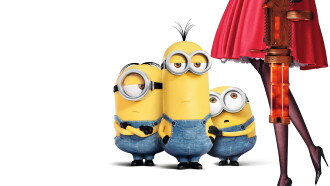
Minions Stuart, Kevin and Bob are recruited by Scarlet Overkill, a super-villain who, alongside her inventor husband Herb, hatches a plot to take over the world.
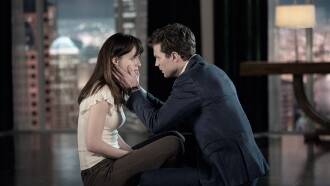
When college senior Anastasia Steele steps in for her sick roommate to interview prominent businessman Christian Grey for their campus paper, little does she realize the path her life will take.
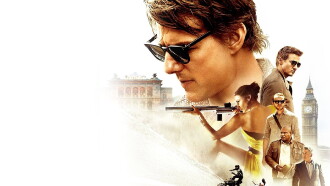
Ethan and team take on their most impossible mission yet—eradicating 'The Syndicate', an International and highly-skilled rogue organization committed to destroying the IMF.
A people's struggle to save the animal at the heart of their culture. For centuries the Bunong indigenous people on the Cambodian-Vietnamese border lived with elephants, believing they shared the same destiny.
What is art and how does it relate to society? Is its value determined by its popularity or originality? Is the goal profit or expressing one's personal vision? These are some of the questions raised as we follow fiercely independent New York artist Robert Cenedella in his artistic journey through decades of struggling for creative expression.
The year is 2029. John Connor, leader of the resistance continues the war against the machines. At the Los Angeles offensive, John's fears of the unknown future begin to emerge when TECOM spies reveal a new plot by SkyNet that will attack him from both fronts; past and future, and will ultimately change warfare forever.