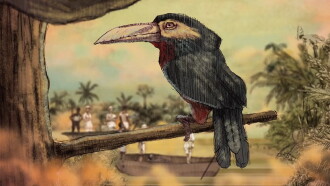
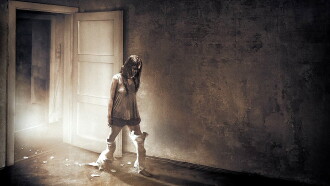
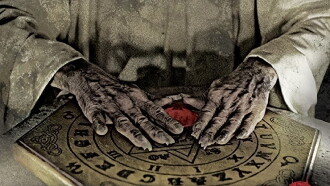
This video presents an algorithmic, generative, and software-driven dataset of images that runs in 15-hour cycles. The sequenced, glitched imagery derives from the brilliant and melodramatic Shanghai version of "Phantom of the Opera" made in 1937. For this video, the launching time of my original software occurs 23:55 (Sept. 20, 2015) just prior to midnight. At precisely midnight, an algorithm is designed to trigger the start of the central song of "Yeban gesheng" - the politically convoluted and emotionally intense "Song at Midnight".
Humpback Whales takes audiences to Alaska, Hawaii and the Kingdom of Tonga for a close-up look at how these whales communicate, sing, feed, play and take care of their young.
The story of the modern Los Angeles film industry as a series of monologues. The monologues are delivered by various characters, including a writer, a director, a producer, an actress, and a soccer mom.
Itso, about 35, drives a special ambulance called a 'corpse-van'. His job is to pick up the bodies of the recently deceased and transport them to the morgue.
Armed with the astonishing ability to shrink in scale but increase in strength, master thief Scott Lang must embrace his inner-hero and help his mentor, Doctor Hank Pym, protect the secret behind his spectacular Ant-Man suit from a new generation of towering threats.
The octogenarian Angono Mba recalls the expedition in which he worked as porter for the Spanish filmmaker Manuel Hernández Sanjuán who, between 1944 and 1946, traveled through Spanish Guinea documenting life in the colony as he obsessively searched for a mysterious lake.
A prequel set before the haunting of the Lambert family that reveals how gifted psychic Elise Rainier reluctantly agrees to use her ability to contact the dead in order to help a teenage girl who has been targeted by a dangerous supernatural entity.
After the death of a group of teenagers using the Ouija, the psychologist Fernanda and her son return to Peru, but they will find themselves surrounded by an evil entity as big as its wicked sect.
The year is 2029. John Connor, leader of the resistance continues the war against the machines. At the Los Angeles offensive, John's fears of the unknown future begin to emerge when TECOM spies reveal a new plot by SkyNet that will attack him from both fronts; past and future, and will ultimately change warfare forever.
Comments
Have you watched Optical De-dramatization Engine (O.D.E.) applied in 15-hour cycles to Ma-Xu Weibang's ‘Yeban gesheng’ (Song at Midnight), 1937 yet? What did you think about it?