Most Popular Evelyn Lambart Trailers
Total trailers found: 24
01 January 1960
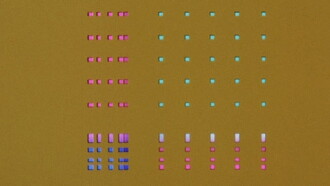
An experiment in pure design by film artists Norman McLaren and Evelyn Lambart. Lines, ruled directly on film, move with precision and grace against a background of changing colors, in response to music specially composed for the films.
21 June 1976
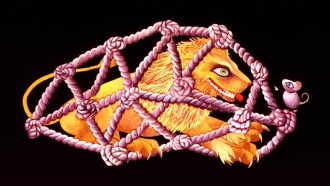
This animated short by Evelyn Lambart is a visual adaptation of the famous Aesop fable "The Lion and the Mouse," in which a mouse proves to a lion that the weak and small may be of help to those much mightier than themselves.
29 July 1965
A man sets a ping-pong ball into motion and it becomes fruitful and multiplies.
01 January 1947
Development in long-range travel and the growing importance of the Arctic and Antarctic regions make it necessary to understand how maps may be misleading.
03 May 1951
Early abstract 3D film by animation master Norman McLaren.
20 June 1970
This short animation by artist and animator Evelyn Lambart offers a wordless plea for the right of all living creatures to a clean, unpolluted environment.
01 October 1949
In this extraordinary short animation, Evelyn Lambart and Norman McLaren painted colours, shapes, and transformations directly onto their filmstrip.
21 June 1973
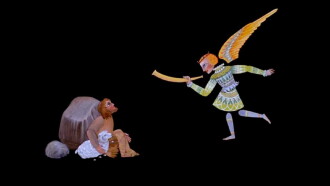
This short animation tells the familiar story of Christmas in an innovative and colourful way. Filmmaker Evelyn Lambart uses glowing zinc cut-outs to give this traditional tale a contemporary twist.
01 January 1968
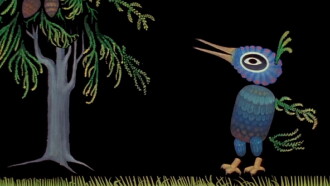
Two duelling birds get the urge to change their plumage. A blue jay wants to be decked out in the green of cedar, and a loon dons the burnished red of oak leaves, but neither bird foresees the consequences of vanity.
01 January 1980
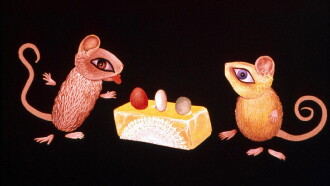
In this animated short, Evelyn Lambart uses her well-known style of animation – paper figures and brightly colored backgrounds – to revisit Aesop’s tale of 2 mice with vastly different lifestyles.
01 January 1974
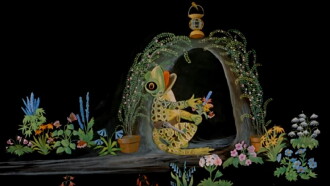
In this short film by animator Evelyn Lambart, a handsome frog courts and wins a mouse for his bride.
12 May 1973
Pinscreen animation makes use of a screen filled with movable pins, which can be moved in or out by pressing an object onto the screen.
01 January 2006
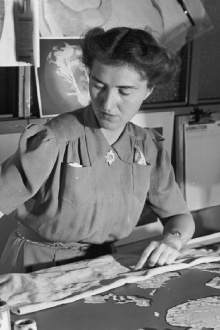
The fifth thematic mini documentary about revolutionary filmmaker Norman McLaren; this time with a focus on his collaborator Evelyn Lambart.
01 January 2006
This 1967 footage shows McLaren at a computer with Evelyn Lambart, Rene Pardo and two other technicians, followed by the animation test some call Birdlings.
01 January 2014
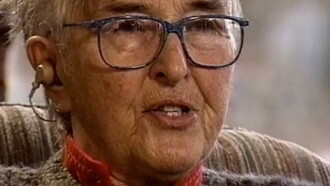
Animation pioneer Evelyn Lambart recalls arriving at the NFB in the 1940s, her celebrated collaborations with Norman McLaren and her approach to her solo work.
01 January 1969
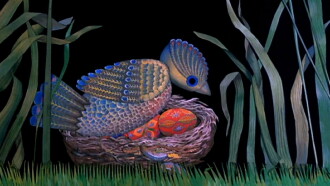
A greedy little blue jay carries away whatever his beak can grasp. Berries, birds' eggs (nests and all), and even the sun in the sky go into his secret cache.
31 December 1950
The story of the settlement of Canada, illustrated with cheerful animated cartoons. The arrival of Jacques Cartier, the fishing and fur trades which followed, and the rival colonization by the French and British, climaxed by the battle of the Plains of Abraham, are depicted.
01 January 1951
Early abstract 3D film by animation master Norman McLaren and collaborator Evelyn Lambart.
18 September 1957
An ordinary-looking chair refuses to be sat upon.
01 January 1962
An experiment in pure design by film artists Norman McLaren and Evelyn Lambart. Lines, ruled directly on film, move with precision and grace against a background of changing colors, in response to music specially composed for the films.
01 January 1952
This very short stereoscopic film by Evelyn Lambart uses drawings to suggest movement across Canada’s ever-changing countryside.
01 January 1959
A color cocktail by Norman McLaren and Evelyn Lambart, translating into moving patterns of color and light the moods of music written for a jazz ensemble by Eldon Rathburn.
01 January 1955
This film probes the perennial miracle of the growth of a seedling, the seasonal upsurge of life in a forest giant, and the mysterious alchemy of a single leaf.
19 January 1956
On a blue background, a series of numbers (1 to 5) begin to appear, forming simple arithmetic equations that create a pattern.