Frans van de Staak Trailers
Marmer TrailerItaliaans concert TrailerNuisance Trailer
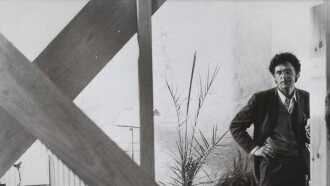
Frans van de Staak (1943-2001) studied at the Netherlands Film Academy from 1963 on. He financed his first films usually from his own savings for his work as a graphics artist. His films can be characterised by a consistent investigation of (cinematographic) space, time, language, images and movement in their mutual relations. His first full-feature, The Imperfect Tulip, was completed by Van de Staak in 1980. He is also producer and cutter for other filmmakers.
Most Popular Frans van de Staak Trailers
Total trailers found: 34
03 December 1992
A portrait of a woman and 26 witnesses who appear to be accusing her of something but we'll never know what.
25 May 1989
Two couples. The four characters are played by eight actors. There is little dialogue. Sometimes a couple does not seem to live together, just to be alive together in the same room.
22 March 1990
A bus driver on a regular route in the 'polder' moves into a new house with his wife. They are the first inhabitants of a new estate.
01 January 1998
An actress and an actor overhear parts of the play "Three Travelers Watch Sunrise" by Wallace Stevens (1879-1955).
01 January 1982
The film consists of 43 scenes which are fragments and do not tell a story but may be compared to musical intermezzi - they give the impression that they have been slotted in between other scenes, but the nature of these other scenes is not made clear.
01 January 2001
The protagonist in the film is an actor (René van het Hof) who is acting his life. He is a nuisance, but only for those who have had enough of his play acting or who are ashamed to be around this clown.
01 January 1980
This film is Frans van de Staak's first full feature, for which he wrote 28 scenes and worked with a cast of 29 actors and 29 actresses.
01 January 1994
The film is adapted from a play by Cyrille Offermans Lichtenberg, scenes at the dawn of a new era". Although the protagonist shares some features with the experimental physicist and writer George Christoph Lichtenberg (1742-1799), who wrote the famous Sudelbücher and numerous letters, the film does not pretend any historical accuracy with respect to the real Lichtenberg, but focuses on Offermans' hybrid [partial fictitious] personage.
01 January 1985
La terra in due means the earth of the landlords versus that of the peasants who actually cultivate it.
19 September 1996
Every scene of the film comprises a dialogue between a man and a woman. The dialogues are fragmentary, in other words, the dialogue in one scene does not tie in with that of the next.
29 January 1996
Like in his short Ten poems of Hubert Kzn Poot (1975) there is just one protagonist in Sepio. A woman is immersed within a landscape in summertime and she adores her beloved one in everything that emerges from her surroundings.
01 January 1990
Documentary about the work of Venetian painter Carpaccio.
01 January 1992
Masquerade by mother and daughter as Salomé and Herod.
01 January 1975
Ten poems from Hubert Korneliszoon Poot from the Dutch farmer and poet Hubert Poot, who lived in the 18th century -declared by Donald de Marcas [actor].
01 January 1970
A girl visits a place where a boy and another girl stay for a while. Afterwards they all leave. The film was shot in a period of two weeks, with one week of rest in between.
01 January 1973
From Spinoza's Ethica 82 sentences were selected without a strict coherence and re-assembled in seven components.
01 January 1986
Constructed around two poems by Gerrit Kouwenaar, who reads his own verse off- screen. The film focuses on a man and woman packing, going away, arriving at their destination, packing again, and going back to square one.
01 January 1975
A film poem in which the words, spoken by an actor, do not refer to concrete objects or "reveal their meaning" but function like notes in a musical score.
01 January 1974
The Dutch writer Hendrik Cramer (1844-1944) lived and worked in Paris when he published (1933) a screenplay for a documentary Un pied cassé, Documentaire in Les Cahiers Jaunes.
01 January 1983
Jacq Vogelaar and Frans van de Staak cooperated in a sort of struggle between language and film: their perspectives are different, even exclusive.
01 January 1977
Seven persons, who didn't go to work, stayed together all day long while looking for a gift to surprise their boss.
01 January 1975
Amsterdam 1975. Images of "Keizerrijk", a narrow passage [alley] in the center of the city, nearby the Bungehuis.
01 January 1966
The painter Frank Lodeizen filmed at work and in his surroundings.
01 January 1977
Political texts from the journal In Search, edited by M.S. Arnoni (Wim Schlebaum)
01 January 1978
Four persons travel by rail to visit a city. On arrival they take a bicycle to continue their tour and join occasionally a passing protest manifestation.
01 January 1966
Application of double frame technics with two synchronized 16mm projectors. Each frame functions alternately as the [abstract] painter's canvas and as a 'concrete' filmscreen itself.
01 January 1976
Talk to the landscape; texts from Friedrich Griese (Wim Schlebaum)
01 January 1977
A story by Alphonse Daudet about a hunting-scene seen through the eyes of a partridge. (Wim Schlebau)
01 January 1981
The film consists of 25 scenes. Each scene is performed by eight actors [out of a group of nine]; the ninth actor continually changing places with another actor who appears in only one or two scenes.
01 January 1990
Poet Hans Faverey reads from his own work.