Gary Hill Trailers
Gary Hill: I Believe It Is an Image TrailerSkaterdater Trailer
Gary Hill (b. 1951, Santa Monica, CA) has worked with a broad range of media – including sculpture, sound, video, installation and performance – since the early 1970’s, producing a large body of single-channel videos, mixed-media installations, and performance work. His longtime work with intermedia continues to explore an array of issues ranging from the physicality of language, synesthesia and perceptual conundrums to ontological space and viewer interactivity. (Vimeo)
Most Popular Gary Hill Trailers
Total trailers found: 46
01 January 1976
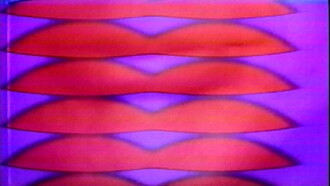
In Mirror Road, Hill uses the camera and image processing devices to explore the malleability of electronic colors and image density.
01 January 1978
“The image plane is divided into three sections. In the lower half, a close-up of two hands form a circle out of a metal rod.
01 January 1974
The strategy for recording and composing Air Raid was derived from sound rather than image. This produced some unusual juxtapositions between images found in the everyday: a lawnmower, the wrapping of fruit with tin foil, a cement mixer, record player, television, and among others, the eerie image of an air raid siren.
11 November 1965
The film tells a story with no dialogue. The group of boy skaters are suddenly at a point when one of the boys sees a young girl, and becomes interested in her.
01 January 1978
The artist’s mouth fills the whole image plane. Silently the words “red,” “blue,” “green” are slowly and repeatedly articulated.
17 January 1989
With startling precision, Site/Recite moves across and around a table-top graveyard — bones, butterfly wings, egg shells, seed pods, crumpled notes, skulls — in a series of seamless edits that present a continuous flow of detailed close-ups.
01 October 2000
DVD insert of monograph Gary Hill: Around & About: A Performative View containing a compilation of Hill's performance art.
01 January 1980
This piece was originally planned by the artist as a reading for the Viewpoint series at New York’s Museum of Modern Art.
01 January 1979
Objects from the artist’s studio (hammer, cathode ray tube, circuit board rack, chair, clip light) constitute the subjects for a series of short sequences in which a single object moves through a series of overlapping transformations.
01 January 2008
Observaciones Sobre los Colores consists of a single video projection in which a boy reads a Spanish translation of Wittgenstein's Remarks on Color, Part 1 (1951), consisting of 88 segments, in real time over a period of 78 minutes.
01 January 1975
A humanoid form strikes its body while making primal guttural sounds. At times the form is “stopped” and “started” using the pause of a reel-to-reel video player—a frozen line of noise (an asynchronous frame) cuts through the image reinforcing the sense of physicality.
01 January 1979
Two color video cameras, two microphones, Dave Jones prototype modules (input amplifiers, variable soft/hard keyers, output amplifier, analog-to-digital converter, bit switch, digital-to-analog converter), assorted speaker cones, enclosed speaker, sand, large spike nails, lighter fluid, lighter, amplifier, wire, and water.
01 January 1980
“Made just before Around & About, this work is something of a ‘manifesto in jest’ against television….
01 January 1979
A single solid white line rotates 180 degrees, beginning at a vertical position in the middle of the screen.
01 January 1984
This tape is the first of Hill’s works for which he deliberately wrote a screenplay. The title defines the piece’s starting point: Alice in Wonderland asks her omniscient father why things get in a muddle.
01 January 1977
Our visual field is dominated by gossamer layers that become distorted in fluid motion, break off, begin anew and continually change color.
01 January 1980
“In 1979-80, I was teaching in the Media Studies Department at the State University of New York at Buffalo, filling in for Woody and Steina Vasulka, who had left for Santa Fe.
01 January 1975
“I was thinking of the camera as a kind of archeological tool that I could use to dig into or slice through the landscape —one among many studies toward using the camera in a highly physical way.
01 January 1976
A fixed color camera is slightly defocused on the wire mesh of a window screen. Outside the window the leaves of trees are moving with the wind.
01 January 2008
Figuring Grounds – like Tale Enclosure, 1985 – was edited from three hours of recordings made at the Stained Glass Studio in Barrytown, New York, where Hill’s Why Do Things Get in a Muddle? (Come On Petunia), 1984, was also taped.
21 October 1978
Silent or with minimal sound, Hill's early formalist works explore the manipulation of electronic color and image density through the camera obscura and image processing devices.
01 January 1981
1980-81, 13:27 min, b&w, sound Videograms is an ongoing series of text/image constructs or syntaxes using the Rutt/Etra Scan Processor, a device that enables Hill to sculpt electronic forms on the screen.
01 January 1978
The basis of this “sound/image construct,” recorded in real time, are three black-and-white still images: a keyboard, a flute, and an African drum.
01 January 1986
Recorded on location in Japan, this work was inspired by the notion of “acoustic palindromes,” aural versions of written palindromes, located in the Japanese language.
01 January 1981
This work is the single-channel version of a multi-channel installation of the same name. The picture plane is divided into a left and a right half.
01 January 2011
The Psychedelic Gedankenexperiment is a declaration claiming the psychoactive event of lysergic acid diethylamide (LSD) as a "found performance" and as "the art experience par excellence.
01 January 1974
Recorded in Woodstock, New York, Rock City Road incorporates multiple levels of rescanned images of walking on different surfaces, including pavement and snow-covered terrain.
01 January 1988
Disturbance (among the jars) is a multi-lingual adaptation of selected Gnostic texts from the Nag Hammadi library discovered in 1945/46.
01 January 1977
The work’s images appear as visualizations of electronically generated sounds. Initially, small pulsating pixel structures occasionally appear on the black screen.
01 January 1985
Returning to the primal source of language, Hill explores the physical and subconscious origins of speech.
01 January 2003
Blind Spot constructs a space of living portraiture by “focusing time” on an exchange between the artist (the camera) and a man on the street in the small Algerian neighborhood of Belsunce in Marseille, France.
01 January 1980
Using the phenomenon of inverted (or negative) video feedback, this work constructs a one-to-one correspondence between recited text and image.
01 January 1977
Our visual field is dominated by gossamer layers that become distorted in fluid motion, break off, begin anew and continually change color.
21 October 1983
The associative stream of images and sounds treats the word as an abstract structure. Spoken and written text flows from image to image, morphing into the shape of a circle, triangle or square.
01 January 1977
In Bathing, as in his Mirror Road, Windows and Objects with Destinations, Hill uses the camera and image processing devices to explore the malleability of electronic colors and image density.
01 January 1978
One of the earlier works Hill produced on the Rutt/Etra video synthesizer, Elements combines abstract “landscapes” with fragmented syllabic language.
01 January 2004
In this program video artist Gary Hill uses a number of his pieces to investigate otherness and ambiguity, dislocation of the senses, the boundary between words and comprehension, the physicality of text, and figurative interactivity.
01 January 1979
“A structural work (with humor) that uses indeterminacy to forge an abstract landscape upon which the ‘vision’ of an ox appears.
01 January 1980
This rarely screened film was used to raise funds for the making of Energy and How to Get It. High-energy physicist Robert Golka was granted a lease on an airplane hangar once used to build B-29 bombers to further his experiments on ball lightning and free energy distribution.
01 January 1979
In this work, the field of Hill’s experimentation is the synchronization of visual and linguistic elements.
01 January 2001
Goats and Sheep uses the source material of the installation Withershins, 1995, consisting of two simultaneous views of a person signing: the hands and arms are framed in one, and the back of the head and top of the shoulders in the other.
01 January 1978
Dave Jones prototype modules (keyers, color field generators, output amplifier), black-and-white cam)
01 January 1986
“The beginning of a remake of an earlier work [Soundings, 1979] in which I wanted to extend the reflexivity of each text in relation to the interaction between different physical substances—in this case, sand—and the speaker cone.
01 January 1990
Solstice d’Hiver was Hill’s last single-channel video before the recently completed Goats and Sheep and Blind Spot.
01 January 2012
Two channel video installation.
A spoken text …rummages through piles of surplus; boxed accouterments and that unaccounted for miscellanea… and the uneasiness of language itself as it grapples with the whereabouts of the necessary words.
05 May 1988
In the video, Thomas the protagonist is played by Hill which confounds the self-reflexive nature of the book’s relationships all the more, making the video something of a “transcreation.