Grigori Aleksandrov Trailers
Sergei Eisenstein: Mexican Fantasy Trailer¡Qué Viva México! TrailerStarling and Lyre Trailer
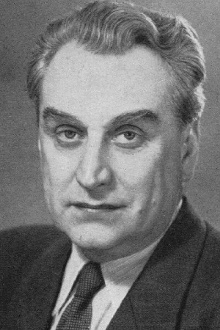
Grigori Vasilyevich Aleksandrov or Alexandrov (original family name was Mormonenko; 23 January 1903 - 16 December 1983) was a prominent Soviet film director who was named a People's Artist of the USSR in 1947 and a Hero of Socialist Labor in 1973. He was awarded the Stalin Prizes for 1941 and 1950.
Initially associated with Sergei Eisenstein, with whom he worked as a co-director, screenwriter and actor, Aleksandrov became a major director in his own right in the 1930s, when he directed Jolly Fellows and a string of other musical comedies starring his wife Lyubov Orlova.
Though Aleksandrov remained active until his death, his musicals, amongst the first made in the Soviet Union, remain his most popular films. They rival Ivan Pyryev's films as the most effective and light-hearted showcase ever designed for Stalin-era USSR.
Most Popular Grigori Aleksandrov Trailers
Total trailers found: 46
24 December 1925
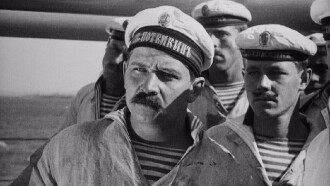
A dramatized account of a great Russian naval mutiny and a resultant public demonstration, showing support, which brought on a police massacre.
28 April 1925
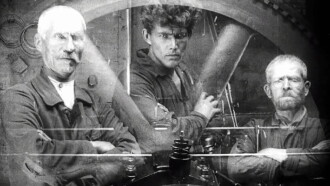
Workers in a factory in pre-revolutionary Russia go on strike and are met by violent suppression.
16 October 1943
The film is about the Soviet People's patriotism and friendship.
09 December 1934
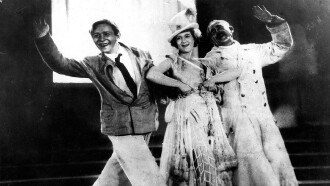
Merry Fellows was the first Soviet musical comedy. Set in Odessa and Moscow in the 1930s. Shepherd Kostya Potekhin is mistaken for an international concert star.
01 January 1967
An epic presentation of the turbulent days leading to the Russian Revolution. Based on the classic work by John Reed, this important documentary makes use of rare footage and little-known information, stirringly narrated by Orson Welles.
11 May 1928
Sergei M. Eisenstein's docu-drama about the 1917 October Revolution in Russia. Made ten years after the events and edited in Eisenstein's 'Soviet Montage' style, it re-enacts in celebratory terms several key scenes from the revolution.
01 November 1963
“The Magic Beam” is a film essay woven together from newsreels and documentary material from different decades, fragments of hundreds of non-fiction and fiction Soviet films of the 1910s-1960s.
16 November 1944
Designed as a successor to "They Met In Moscow", with the same director, star and composer, "Six P. M.
06 June 1985
A documentary on the life of the famous actress, deceased wife of the director Grigoriy Aleksandrov.
25 May 1936
An American circus performer finds herself the victim of racism after it is revealed that she's the mother of a mixed-race child.
06 June 1952
The young composer Mikhail Glinka performs his new work at a soiree at earl Vielgorsky's house. However, the public is accustomed to Western music, and reacts coldly to the creation of the composer.
30 September 1940
Second attempt to create a feature film out of the 200,000-plus feet of film which Soviet film-maker Sergei Eisenstein shot during 1931-32 in Mexico for American socialist author Upton Sinclair, his wife and a small company of investors.
05 August 1953
March 9th, 1953. A gray, sad day. Clouds float low over the Kremlin towers. A city that unrecognizably grew, prettier and matured - this Moscow froze in solemn grief.
01 January 1958
Documentary made for the 60th anniversary of Soviet director Sergei Eisenstein.
25 September 1929
Also known as The Old and the New, The General Line illustrates Lenin’s stated imperative that the nation move from agrarian to industrial culture in an epic ode to farm-collectivization progress.
21 September 1945
The famous actress Kruchinina graciously agrees to tour in a town with which she has heavy memories, and finds there a son, left by her due to circumstances many years ago.
28 August 1945
This literary adaptation was the first Soviet feature length dramatization, as opposed to documentary film, on the momentous Battle of Stalingrad.
01 October 1979
Having revolutionized film editing through such masterworks of montage as Potemkin and Strike, Soviet director Sergei Eisenstein emigrated West in hopes of testing the capabilities of the American film industry.
01 June 1944
In September 1941, lieutenant Ilya Streltsov, who graduated from the flight school, was assigned to the fighter aviation regiment guarding the sky of Moscow.
02 July 1947
A drab woman scientist, working on machine to harness solar energy, and a pert concert singer look-alike being courted to play her in a movie swap identities and find personal growth, professional success, love, and happiness.
27 June 1960
The end of the 1950s. The Chinese passenger plane, following the Beijing-Moscow flight, enters a thunderstorm and makes an emergency landing in the Baikal region.
03 January 1944
The story takes place in Summer 1942, when a small force of Black Sea Fleet sailors was surrounded by German troops but broke out the encirclement.
07 October 1940
Tanya Morozova, an illiterate but industrious textile factory worker, finds happiness through her education and the Stakhanovite movement.
24 August 1943
Archive footage from Potemkin (1925), with English dialogue dubbed in by American actors, is combined with new footage to tie together the brave stand of Odessa Russian guerrilla bands of the 1940's against German forces with the similar situation of 1905 when Odessa citizens aided in the revolt against the Czar as depicted in Eisenstein's classic Potemkin (1925).
31 July 1967
A test film for black-and-white television, made by Mosfilm in 1967. A girl dreaming to be in movies got a call from Mosfilm, asking her to be filmed.
22 January 1931
Footage of the aftermath of the January 14 1931 earthquake in Oaxaca, Mexico.
14 July 1944
The bank is preparing to solemnly celebrate the 15th anniversary of the institution. And at that moment, two events took place that turned everything upside down.
09 April 1945
A Russian peasant woman is captured by Nazis and sold into slavery in Germany. Shown in Cannes in 1946.
24 December 1945
A funny comedy about a lost twins and a lot of good people who are involved in a search for twins' parents.
07 February 1945
November 1941. One by one, the men leave, leaving only old men, women and children in the village of Bykovka.
16 June 1974
Soviet intelligence spouses — Lyudmila ("Lyre") and Fyodor ("Starling") Grekov at the beginning of the Great Patriotic War are tasked with settling in Germany.
16 March 1949
Soviet and American soldiers are meeting on the shores of the Elbe river in Germany in 1945.
24 April 1938
Widely claimed to be Joseph Stalin's favorite movie, this classic musical comedy is a must-see. The action takes place on a steamboat on the iconic Volga River, as two groups of performers travel to Moscow to perform in the Moscow Musical Olympiad.
21 May 1923
Filmic insert to Eisenstein's modernized, free adaptation of Ostrovskiy's 19th-century Russian stage play, "The Wise Man" ("Na vsyakogo mudretsa dovolno prostoty").
26 June 1934
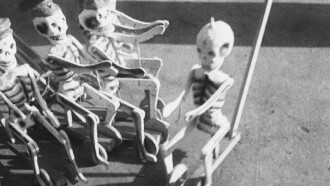
During his adventure in Mexico, Sergei Eisenstein made footage of a Mexican "Death Day" celebration for inclusion in his "Que Viva Mexico!" film project.
28 February 1931
Romance sentimentale is a 1930 French film directed by Grigori Aleksandrov and Sergei M. Eisenstein. A short, experimental, slightly poetic montage of city and abstract images.
22 September 1933
As was common in Diaz's Mexico, a young hacienda worker finds his betrothed imprisoned and his life threatened by his master for confronting a hacienda guest for raping the girl.
05 February 1930
This film shows contrasting views of women with problematic pregnancies and the outcomes resulting when they seek out a back-alley abortionist, a trained and licensed abortion provider in a clinic, or an obstetrician capable of performing a Caesarian Section.
12 June 1953
The main film character, an ordinary peasant Martyn Borylya, decided to get a noble order. Having chosen a little and primitive aim, in the chase of the artificial values, he loses everything.
12 February 1998
Eisenstein shot 50 hours of footage on location in Mexico in 1931 and 32 for what would have become ¡Que viva México!, but was not able to finish the film.
21 October 1930
Story of the conflict between old art forms such as ballet and the revolution and the need for creating new, proletarian forms of art.
01 January 1962
About a hard-working girl who was obedient to the sky and fields. She floated between the clouds, helped the plants, grew healthy grains, but her neighbor failed.
08 March 2006
A remake of the Grigoriy Aleksandrov's "Volga-Volga", a postmodernist deconstruction of the legendary Soviet movie.
22 September 1943
The Great Patriotic War. The Soviet submarine T-9, passing through the minefields of the North Sea, penetrates the enemy port.
30 April 1933
On the 15th anniversary of October. Covers the period from November 7, 1917, to November 7, 1932. The main character is a fifteen-year-old Komsomol member.