Jeff Keen Trailers
Art Flies Free TrailerBlatzom TrailerReturn of Silver Head Trailer
Jeff Keen (1923–2012) was a pioneer of experimental film whose rapid-fire animations, multiple screen projections and raucous performances redefined multimedia art in Britain.
Keen was a veteran of the Second World War, and his work powerfully evokes the violence, colour, speed and noise of the 20th century. He transformed cinema into a riotous collage of comics, drawings, B-movie posters, plastic toys, burning props and extravagant costumes. His early 8 mm and 16 mm films are built for speed, combining footage of Beat-era motifs – jazz, motorbikes and car culture – with experimental animations in which the achievements and atrocities of the 20th century seem to flash by within a few short, cacophonous seconds. A single frame could not contain the frenzied energy of Keen’s imagination, and by the mid-1960s he began to use multiple screens and live action in presentations of his work.
Most Popular Jeff Keen Trailers
Total trailers found: 53
02 January 1970
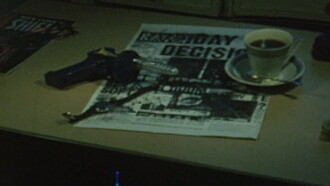
Rayday Film was shown projected in several 100-foot length parts from multiple projectors. The friends and family who featured in costume and character within - like Motler, the Word Killer who reflects Keens preference for action over thinking - performed similar actions in front of the screen.
01 January 1961
A deliberately non-synchronous film, shot in 8mm with the sound on tape. Piero Heliczer reads his poem "The Autumn Feast," and the visuals interact with, but does not literally represent, what is read.
02 January 1972
One of Jeff Keen's diary films. Keen made many diary films with his daughter, wife and friends in the late 60s and 70s.
02 January 1976
One of Jeff Keen's diary films. Keen made many diary films with his daughter, wife and friends in the late 60s and 70s.
02 January 1969
Experimental short directed by Jeff Keen.
02 January 1989
This relatively unknown Jeff Keen film presents an insistent series of exquisitely composed action ad
01 January 1994
Short video by Jeff Keen.
02 January 1960
Experimental short featuring motorbikes and animation. This is the second version of Jeff Keen's first film; that film became too worn.
02 January 1961
America comes to Brighton as three beatniks hang out, listen to records and smoke before strange hats appear out of nowhere and a cartoon bubble suggests they go to the cinema.
02 January 1979
Action and animation are pushed to the extreme in this frenetic film. Keen makes references to the God-like status of the director, the framed world of the cinema and the history of popular entertainment.
02 January 1975
One of Jeff Keen's diary films. Keen made many diary films with his daughter, wife and friends in the late 60s and 70s.
02 January 1990
Treating apocalyptic and aggressive imagery with silence and slow washes of colour, Jeff Keen exhibits and works against his usual tropes.
02 January 1965
Jeff Keen thought that some of his previous films had been dominated by long-shots. In this film he grapples with the language of cinema, not as a means to inspire audience identification, but rather to make up for an imbalance.
01 January 2000
A Super-8 portrait of Jeff Keen. This short but evocative experimental portrait melds Keen's style with that of its maker, Ian Helliwell, another artist filmmaker based in Brighton.
02 January 1993
The Artwar face peers through painted celluloid and a barrage of explosions and film noise.
02 January 1994
This version of Artwar builds from performances with paper masks and implements and various sequences of gunfire.
02 January 1968
Made to represent an entire cinema programme, Meatdaze consists of six sections that include cartoons, supporting and main features.
02 January 2002
'Omozap Terribelis' was shot on video and screened alongside 'Afterblatz 2'. It uses the toy 'My First Sony' to present a number of computer-generated drawings.
01 January 1965
Silent 8mm film.
02 January 1962
Breakout is an unfinished film and, unusually for Keen, contains a loose narrative. It presents the story of a young man hounded by a large pink Pontiac Continental.
02 January 1991
Omozap is a gun-wielding wildman and Keen anti-superhero akin to The Punisher. Compulsive animation and action look to the Artwar films and videos to come.
01 January 1964
The Pink Auto, screened using two projectors, is one of the very first examples of expanded cinema. Jeff Keen walks as a zombie and carry his dead bride through brown English fields.
02 January 1972
Named after the horror film White Zombie and the rom-com Red Dust (both 1932), White Dust follows the friends and family of Keen while they explore archetypal characters of Hollywood and myth.
02 January 1975
One of Jeff Keen's diary films. Keen made many diary films with his daughter, wife and friends in the late 60s and 70s.
02 January 1991
Stealth bombers hover over crashing waves and ruined land. Using found footage and several thick layn
02 January 1990
The Artwar loops were made for non-cinematic exhibition and go from harsh film surface noise to colour bars and other video effects filmed from the TV.
02 January 1980
The Keen family go on holiday in the jungles of the English countryside while the mysterious Silver Head - Jeff Keen wearing an inside-out, silver-lined photographic paper bag - haunts Brighton and the snowy fields of winter.
02 January 1993
For this video, Jeff Keen had all his images for the Artwar series run together and over the top of each other.
02 January 1990
Produced by Jeff Keen for looping in an exhibition context.
01 January 2006
Experimental animation created using a video pen.
02 January 1991
Omozap is a gun-wielding wildman and Keen anti-superhero akin to The Punisher. Compulsive animation and action look to the Artwar films and videos to come.
02 January 1980
A short, sharp, visceral attack on the news using, amongst other things, science fiction footage and scattered newspaper headlines.
01 January 1968
White Lite is something of a mystical film, evoking the feeling of going 'through the looking glass' to another world, despite the fact it was largely shot in the flat of its director, Jeff Keen.
02 January 1990
This vibrant montage of colours and positive and negative images shows Jeff Keen filtering and reflecting on his previous films.
02 January 1969
Various different holiday locations ar joined together through the pleasures of ice cream in The Mutt & Jeff Icecream Sundae, while in Mothman the strange title character crawls through roof-top windows and we see footage of a funfair.
02 January 1990
The Artwar loops were made for non-cinematic exhibition and go from harsh film surface noise to colour bars and other video effects filmed from the TV.
02 January 1986
Jeff Keen dons paper masks and his knitted Artwar jacket, after avoiding bombs and pacing a moonlike landscape.
02 January 1990
Jeff Keen processes his cinematic past in this filmic attack on his back catalogue.
02 January 1975
Made between 1970 and 1975, Jeff Keen's films always contain internal layers and films within films. The twenty-four films here include hand-painted work, animation and montage.
02 January 1990
A documentation of Jeff Keen painting, using montage to turn a mild-mannered English painter into a Wild West gunslinger.
02 January 2000
Jeff Keen's final film pushes his conflation of personal history and war even further than before.
02 January 1990
From spinning paper guns to pulsing television screens, from zooms, crosscutting and painted film surfaces to burning paper, Jeff Keen uses all the effects at his disposal to make a series of extraordinary animations where movement is never allowed to stop.
02 January 1995
This compilation work uses Keen's drawing computer, screams and gunfire and proclaims ' enemy territory is outside the frame.
02 January 2002
'Afterblatz 2' was shot on video and screened alongside 'Omozap Terribelis'. It uses the toy 'My First Sony' to present a number of computer-generated drawings.
01 January 1976
Includes: Stolen Moments (1972), Lone Star (1975), Godzilla – Last of the Creatures (1976) and Rosa Canina (1970s).
02 January 1965
Comics, monsters and a zombified Keen are gently desecrated in this paint-flecked film that also features a picture of Jackie Keen crying heart-shaped tears.
02 January 1995
Footage of the first Iraq War is jarringly intercut with shots of the artist painting at the local tip and at home.
02 January 1999
This bright animation cuts from interiors to exteriors and pushes pictures of Keen at different ages up against violent actions and symbols of violence.
01 January 1967
In Cineblatz, the viewer is subjected to a high-impact barrage of evolving images, at once comic and terrifying.
02 January 1984
Jeff Keen's daughter gave him some music and sound effects recorded at the cinema and invited him to use it as the basis for a film.
01 January 1978
Jeff Keen had a chance encounter with a collection of old 78 speed records at a Brighton flea market and used it as an opportunity to create a surrealist film (naming it after the poetry collection by André Breton).
02 January 1965
This early quick-fire cut-up animation melds machine gunfire with scratched film. The soundtrack was made by Keen in 2007 with a wasp synthesizer and a shortwave radio.
05 September 1967
Four minutes of heavily cut-up sound and vision with collage, animation and multiple exposures throughout.