Jiří Weiss Trailers
That Kind of Love TrailerThe Illusion Factory Trailer
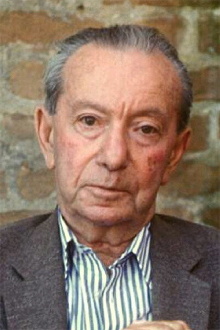
Jiří Weiss (29 March 1913 – 9 April 2004) was a Czech film director, screenwriter, writer, playwright and pedagogue.
Jiří Weiss was born to a wealthy Jewish family in Prague. His father was a Czech patriot and named his son after Czech king Jiří of Poděbrady.His parents were Emil Weiss (1880–1942) and Martha Weissová (née Fuchsová; 1882–1944). Emil Weiss owned a liqueur factory in Libeň district. Since his youth, Jiří was an staunch communist, which was at the heart of disputes with his capitalist parents. As a young boy he was friends with Franz Kafka's niece Marianne Pollaková and thanks to her he was able to read the books of then-unknown writer Kafka in the 1920s.
Weiss was interested in studying at film school, but his parents wished he studied law. While still a minor, he left his home and lived with his friend K. M. Walló [cs]. Weiss started to work as a copywriter in advertising. His father, who disagreed with his life choices and could still make decisions about his underage son, had him institutionalized in a mental hospital. Weiss never spoke to his father ever again. In his early twenties, he started working as a copywriter for the Prague branch of Metro-Goldwyn-Mayer. At this time, he wrote his first book – a story for children O věrné Hadimršce. He befriended leading intellectuals of the Left Front in Prague, including Vladislav Vančura and Ivan Olbracht. In 1934, Vančura invited him to be an assistant cinematographer on his movie Marijka the Faithless, based on Olbracht's book.

Most Popular Jiří Weiss Trailers
Total trailers found: 49
13 April 1962
In a remote Slovak village in the closing days of World War II, a schoolteacher and his young wife find a wounded Russian parachutist in their front yard just as the Germans are coming in to occupy their village.
01 January 1942
A documentary by Jiří Weiss on the Russian Air Force.
25 January 1957
A thirteen-year-old girl whose mother suddenly dies during the birth of her second child is forced to start taking care not only of herself, but also of her father and newborn brother.
01 January 1940
Directed by Jirí Weiss
01 January 1963
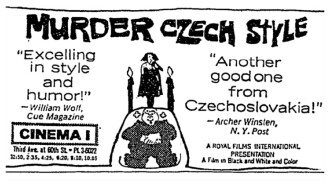
A physically disabled lady is alone in her apartment one evening and has just accidentally overheard a conversation about a planned murder.
15 April 1960
Pavel, a young student living in Prague in 1942, hides a Jewish girl in his apartment building's attic.
10 May 1946
This post-war film from the series Czechoslovak Film Chronicle shows the role of national committees in shaping the new face of the republic.
05 January 1962
Screen adaptation of Julius Fucik's story about communist fighters.
07 January 1955
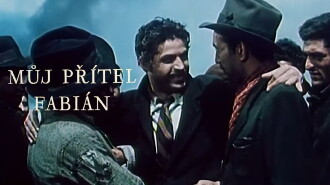
The story of a gypsy named Fabian, who came to work in Kunčice, and his son. Their lives change fundamentally on the great construction site of socialism.
23 May 1958
An orphaned young woman named Jana moves into the household of Robert and his older, possessive wife, Klára.
14 March 1947
Czech film tells the story of a border town in World War II. Family members and friends become enemies.
20 February 1948
The family of Prague greengrocer Pavlas was among the first immigrants to settle in the border village of Severov.
01 January 1942
A documentary edited by Jiří Weiss on the role of Soviet women in the Second World War
29 August 1963
Wandering through the forest, a woodcutter finds a golden fern whose seed turns into a beautiful woman - they fall in love.
01 October 1965
In a Prague shop, an assistant has been carrying on an affair with the dishonest, married manager. An emotionally repressed auditor with domestic problems of his own uncovers serious stock discrepancies.
07 January 1949
An attempted theft of a rare antique is uncovered at a castle that houses an apprentice recreation center.
04 August 1950
A drama set in the Vítkovice Ironworks at the end of the occupation. It depicts the struggle of Ostrava steelworkers to save the blast furnaces, which the retreating Nazis want to blow up.
01 January 1939
Weiss’s classic B&W agitprop short made after his escape to London just ahead of the Nazis. He carried with him three reels of material for his unrealized film ‘Dvacet Let Svobody’ (‘Twenty Years of Freedom’) i.
15 April 1955
A film about a boy who is protective of a runaway dog and the dog, who is protective of the boy.
29 April 1949
A documentary about the 11th All-Sokol Rally in Prague in 1948, focusing in the first part on performances by schoolchildren, youth days, and their parade.
14 November 1947
A comedy about the post-war housing crisis in Prague, which several young people are struggling with.
11 March 1938
In this reportage, film professionals offer the viewers a peek behind the scenes at the Barrandov studios.
01 September 1990
Emil (Vaclav Chalupa as a teen, Ondrej Vetchy as an adult) has been naughty, and his family is at a loss about what to do with him.
26 March 1948
The revolutionary year of 1848 brought great hopes among the hitherto silent classes, awakening social and national hopes.
23 November 1956
The year is 1941 and the German Nazis rule Bohemia with a free hand. Engineer Otakar Racek is an extremely cautious man who tries to avoid problems at all costs.
24 February 1951
The leader of the emerging organized labor movement in the 1880s, Ladislav Zápotocký-Budečský, is exiled to his native village, where he works as a tailor and continues to raise social awareness among members of the working class.
28 October 1949
Cold War Spy FIlm
20 October 1940
River flowing through Prague, Czechoslovakia. Shots of the city. Bridges, buildings, street scenes, religious buildings, cars driving the streets.
24 February 1967
The protagonist (Rudolf Hrusinsky) is a dull, fat, shy government clerk indulging in voyuerism and ego fantasies.
12 January 1951
A detective drama set just before the unification of our physical education system. Criminal investigators investigate the murder of a football club official, bribery, and manipulation of match results.
30 April 1948
Building a bridge is no simple matter. The city council has to decide between two competing proposals, one of which is submitted by villainous scoundrels and scoundrels who would like to enrich themselves everywhere.
02 March 1934
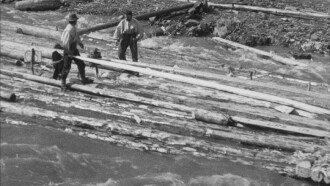
“The Carpathians are medieval!” one character bellows, and this tale of the tree-chopper Petro, his faithless wife Marijka, and various scheming businessmen and foremen does little to disprove the assertion.
01 January 1937
A B&W film poem of the Czech countryside and Weiss’s personal favorite of his early shorts. Mythical images of mountains and streams and rural farmers tilling the land make this a precursor to the mystical visions of the forest in ‘The Golden Fern’.
12 July 1963
During his work assignment in Tamani Kingdom, Czech worker Lojza saves a local man from dying in the desert.
25 March 1949
Karel Doležal, insurance clerk and exemplary father of a family, leaves for a business trip with his secretary Vlasta.
24 February 1937
A lyrical B&W tone poem of the pre-WWII Czech countryside: athletic young men and women canoeing down the River Lužnice, passing medieval castles and sleepy half-forgotten villages.
09 December 1968
The fate of the insignificant poet Leonard Undene is transposed into the media atmosphere of the late 1960s.
25 February 1944
A dramatised account of Norwegian fishermen outwitting occupational forces during World War II, directed by Jiří Weiss and written by acclaimed author Laurie Lee.
02 October 1959
A student commits suicide out of unhappy love to a married man; story is recounted in retrospective by a "judge" who asks the audience to decide who is the guilty party.
01 March 1941
Fantasy in which Eliot Makeham wakes up to find Britain occupied by the Nazis.
12 October 1945
The compilation documentary We Will Remain Faithful is a testimony to the Czechoslovak resistance during the Second World War.
01 January 1945
Day in the life of members of 311th Czechoslovak Bomber Squadron RAF. After a brief introduction of their lives before the war, the narrative focuses on their day: patrolling, training, aircraft maintenance, destruction of a U-boat.