Jocelyne Saab Trailers
Arab Camera TrailerAs Kineastas TrailerBeirut, My City Trailer
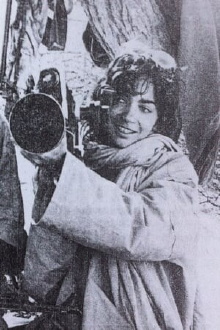
Jocelyne Saab is a filmmaker and a photographer. She was born in 1948 and grew up in Beirut. In 1973, she became a war reporter in the Middle-East, covering the war of October for Magazine 52, the third television channel in France. In 1975 she directed her first feature film, a documentary released in Parisian cinemas: Lebanon in Turmoil, distributed by Pascale Dauman. She will then cover the Lebanese war for fifteen years, during which she directs almost thirty films, including Beirut, never again, broadcasted on France 2 in 1976, Letter from Beirut and Beirut, my city, broadcasted on France 3 between 1978 and 1982. In 1977 both Egypt, City of the Dead and The Sahara is not up for sale and were shot and released in Parisian cinemas. In 1981, she shots Iran, Utopia in the making on the days following the Iranian revolution, which received several international prizes. In 1998, she went to Vietnam and directed a documentary called The Lady of Saigon, which is awarded best French documentary by the French senate. It’s broadcasted on France 2, and in many international festivals.

Most Popular Jocelyne Saab Trailers
Total trailers found: 37
02 January 1987
Focusing on key Arab films produced in the last 20 years. Férid Boughedir traces the development of the film-makers' concern to produce more socially aware cinema.
01 January 1976
Portrait of Raymond Eddé, candidate for the Presidential elections and fervent opponent of the religious war.
02 January 1995
Two young girls of the war generation, Yasmin and Leila, are in search of Beirut. When they meet an elderly film enthusiast with a secret store of Lebanese films, they persuade him to screen his collection for them.
15 October 1981
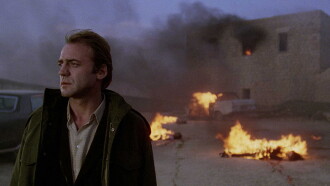
To escape his crumbling marriage, German journalist Laschen travels to Beirut during the fights between Christians and Palestinians to produce an essay.
02 January 1985
Samar, a child of the war, finds relief from the chaos around her through Egyptian movies she watches on television.
01 January 1980
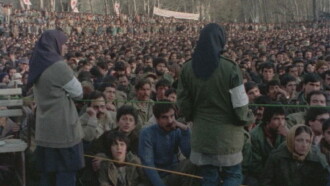
The Iranian revolution leads to the Shah’s downfall and installation of the Islamic Republic. Avoiding the more sensational elements of the news this film questions Iranian society as a whole to try to understand what this wave of change means for the Muslim world.
01 January 1974
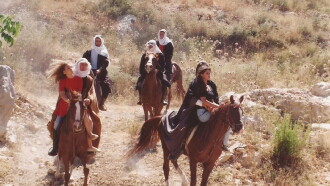
Palestinian women, the often-forgotten victims of the Israeli-Palestinian war, are here given a voice by Jocelyne Saab.
11 November 1982
After living clandestinely in Beirut to escape the Israeli forces, the head of the Palestine Liberation Organization (PLO), Yasser Arafat, left Lebanon aboard the Atlantis for a new exile in Greece and then Tunis.
01 April 1982
Jocelyne Saab toured the city of Beirut devastated by Israeli bombings. She assesses the number of victims and the extent of the destruction.
01 January 1978
Letter from Beirut documents the filmmaker's return to Beirut during one of the lulls, three years after the outbreak of the civil war, animated by the urge to return.
09 August 2026
Seeking to decode a final, unanswered invitation, a filmmaker explores why the renowned Lebanese director Jocelyne Saab reached out for a collaboration just two months before her passing.
01 January 1983
In July 1982, the Israeli army besieged Beirut. Four days earlier, Jocelyne Saab sees her house burn and 150 years of family existence go up in smoke.
01 January 1975
Portrait of a French mercenary working in Libya, hired by the Phalange to train the militias. War leaves its traces; and for some, who see death as part of the job, it’s a vocation.
01 January 1977
This film from the heart of the desert shows the conflict between the Algerians and the Moroccans at El Aioun, and the Saharan resistance of the Polisario Front.
01 January 1976
1976 marks the beginning of Beirut’s calvary. With a child’s eyes the filmmaker follows for six months the daily destruction of the city’s walls.
13 September 2018
A delicate portrait of Mei Shigenobu, daughter of the founder of the Japanese Red Army in Beirut, Fusako Shigenobu.
28 August 1986
The Architect of Louxor is an intimate portrait of Olivier Sednaoui, a disciple of the Egyptian architect Hassan Fathi, as he explains the philosophy behind his decision to build a house using traditional techniques and local resources, linking the ancient to the modern and ‘the infinitely small to the infinitely grand’.
01 January 1978
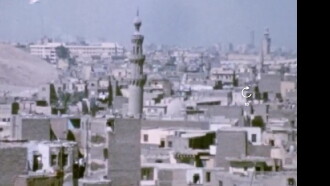
A portrait of the City of the Dead, an inhabited cemetery just outside of Cairo and on the fringes of the city’s public dumping ground, like a living reproach and a bad conscience.
01 January 2016
Poetry is everywhere, even in the refugee camps where absolute misery reigns. In front of old plastic advertising posters on which are drawn in giant format the big icons of luxury and consumerism that make up their shelters, refugee children stand like kings.
01 January 1988
Portrait of a woman, Jocelyne Khoueiry, who, in 1976 during the Lebanese civil war, was the muse of the Phalangist militia in Beirut.
01 January 1986
A singular and poetic evocation of what Alexandria was, a multifaceted city, when it was at the heart of the Arab and European worlds.
01 January 1986
Humiliated by the 1967 defeat, the Egyptian people look for ways to rebuild their sense of identity. Religion seems to point the way for them: Jocelyne Saab portrays the success of the Muslim Brotherhood and the increasingly rigid cultural values taking over Cairo at the end of the 1980s.
01 January 2016
An imaginary post card written to the Turkish writer Orhan Pamuk. Jocelyne Saab writes about her illness, about the fragility of her body, and the situation in the Middle East that is ravaged by war.
01 January 1986
A portrait of the Copts, the oldest Christian community in Egypt, of its links to ancient Egypt and, in the face of rising Islamic fundamentalism, its traditions and way of confronting this growing threat to its existence.
01 January 2009
At bottom is a tale of exploring the imagination of a writer, plus a tale of exploring the city of Beirut.
06 September 2006
A young, free-spirited dancer and student of Arabic poetry falls in love with her thesis supervisor while trapped in a relationship with a man who disapproves of her dancing.
01 January 2013
Six 4-minute short films each filmed in the countries of the Mediterranean, and dealing with expressions of gender, the body, sexuality and identity.
01 January 1976
The cease-fire declared on October 21, 1976, gave the Fedayeen the opportunity to reclaim this area—Fatah territory until it was abandoned in 1970—from the right wing militia.
01 January 1979
Jocelyne Saab, a young Lebanese journalist and director, interviews the director and the film crew while filming Nahla in Beirut.
01 January 1976
A few days after a massacre in a shantytown near Beirut, the director finds the children who survived.
01 July 1975
A few months after the incident of April 13, 1975, during which Palestinian civilians were machine-gunned by Phalangist militiamen, the toll is most tragic: six thousand dead, twenty thousand wounded, incessant kidnappings, a semi-destroyed capital.
01 January 1986
Based on interviews with 15 women, including directors, producers and film actresses, a journey around the world is made, seeing the wars waged by each one against economic and political repression, bombs, police dogs, censors, etc.
04 May 1975
When peace seems impossible, any means are justified to defend a political cause. Hence, on the border separating the Palestinian territories that refuse to recognize the State of Israel, the idea of suicide commandos emerges.
01 January 1996
Portrait of Dr Hoa, an extraordinary woman who was a minister in the South Vietnamese revolutionary government.
01 January 1974
Although peace has been declared, the Palestinians continue to fight Israel for the liberation of their territories.
01 January 1989
Short film about oriental dancers.
01 January 1991
Using laparoscopic instruments equipped with a camera Jocelyne Saab films the in vitro fertilization process as it takes place.