Karuna Banerjee Trailers
Apur Panchali TrailerCalcutta 71 TrailerInterview Trailer
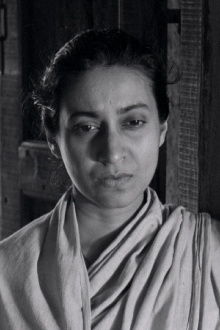
Karuna Banerjee (Bengali: করুণা ব্যানার্জী) was a Bengali actress best known for her role in Satyajit Ray's The Apu Trilogy (1955–1959) as the long suffering mother, Sarbajaya. She was nominated for Best Actress at the 1959 BAFTA Awards for her performance in Aparajito (1956), the second part of The Apu Trilogy. She appeared in a number of other films after that, including Ray's Devi (1960) and Kanchenjungha (1962).
She graduated from the Jogamaya Devi College, an affiliated women's college of the University of Calcutta. Banerjee's acting career expanded over more than two decades in Bengali cinema and theatre. She is best known for her memorable performance as Sarbajaya, the mother in the first two parts of Satyajit Ray's The Apu Trilogy: Pather Panchali (1955) and Aparajito (1956). Her performance in the latter earned her a Best Actress nomination at the 1959 BAFTA Awards. She acted in a few more films, including two more by Ray, two by Mrinal Sen, and one by Ritwik Ghatak that was never officially released.

Most Popular Karuna Banerjee Trailers
Total trailers found: 11
12 October 1972
The spirit of a condemned 20-year-old student wanders through time, linking together four stories of people struggling for survival in this gritty meditation on poverty, natural disaster and political strife in India.
26 August 1955
Impoverished priest Harihar Ray, dreaming of a better life for himself and his family, leaves his rural Bengal village in search of work.
11 October 1956
Apu and his family have moved away from the country to live in the bustling holy city of Benares. As he progresses from wide-eyed child to intellectually curious teenager, eventually studying in Kolkata, we witness his academic and moral education, as well as the growing complexity of his relationship with his mother.
25 April 2014
Arko, a film student, invites Subir Banerjee, who played the legendary role of Apu, to attend an award ceremony in Germany.
19 February 1960
A devout upper-class Hindu has a vision in a dream that his daughter-in-law is the human incarnation of the Goddess Kali and begins worshipping her.
14 March 1958
Deciding to start a school for girls named after his wife, a zamindar looks for a married couple to manage the establishment.
01 January 1967
In 1967, Canadian documentarian James Beveridge traveled to Kolkata to film director Satyajit Ray at work.
25 September 1959
The school of a remote and poor village shut down, the head master Krishna Prasanna (Chhabi) migrates to city in search of job.
01 January 1959
When a bride vanishes on her wedding day, a web of secrets and forbidden love is exposed. Caught in the crossfire are two young women, each battling against the constraints of caste and tradition.
11 May 1962
Played out in real time, several complex family dramas intersect in the landscape of the Himalayan foothills, allowing the Bengali auteur to examine the class and generational differences of postcolonial India while celebrating the hopes of a society in transition.
13 November 1971
A young Indian man has been assured by an uncle that all he needs to land a lucrative job is to show up to the interview in a Western style suit, but the morning of the interview is fraught with unexpected difficulties.