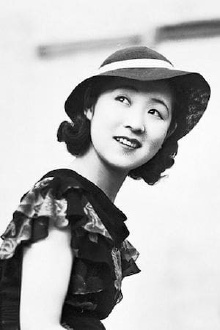
Kinuyo Tanaka Trailers
Kinuyo Tanaka, a Woman We Talk About TrailerThe Travels of Kinuyo Tanaka TrailerLullaby of the Earth Trailer
Kinuyo Tanaka (田中 絹代 Tanaka Kinuyo, 29 November 1909 – 21 March 1977) was a Japanese actress and director.
Tanaka was born in Shimonoseki, Yamaguchi Prefecture, Japan. She became a leading actress at an early age, appearing in Yasujirō Ozu's I Graduated, But... in 1929. The following year she played the lead in Aiyoku no ki, and in 1931 she appeared in Japan's first talkie, The Neighbor's Wife and Mine, directed by Heinosuke Gosho.
She had a close working relationship with director Kenji Mizoguchi, having parts in 15 of his films, including leading roles in The Life of Oharu (1952), Ugetsu (1953) and Sansho the Bailiff (1954). Their working relationship ended when Mizoguchi countered a recommendation from the Directors Guild of Japan for the Nikkatsu studio to hire her as a director. Despite this, the production of her second film as director went ahead, but Tanaka never forgave Mizoguchi, and the reasons for his behaviour are unclear. She also played Noboru Yasumoto's mother in Akira Kurosawa's Red Beard (1965). For her portrayal in Kei Kumai's Sandakan N° 8 she won the Best Actress Award at the 25th Berlin International Film Festival in 1975. Her last screen appearance was in 1976 in Kei Kumai's Kita No Misaki.
Tanaka was the second Japanese woman who worked as a film director, after Sakane Tazuko (1904‐1975). Her first directing job was on the film Love Letter in 1953, and she made five further films in that role.

Most Popular Kinuyo Tanaka Trailers
Total trailers found: 228
26 March 1953
In 16th century Japan, peasants Genjuro and Tobei sell their earthenware pots to a group of soldiers in a nearby village, in defiance of a local sage's warning against seeking to profit from warfare.
04 March 1965
Aspiring to an easy job as personal physician to a wealthy family, Noboru Yasumoto is disappointed when his first post after medical school takes him to a small country clinic under the gruff doctor Red Beard.
29 October 1942
Pretty Oshige is deceived by her first love. After this, she lives a hard lifestyle, working at a number of jobs.
13 April 1939
Eiko is an innocent young lady born into a wealthy family with nothing to offer. She was good at singing, and lived her life playing around with her cronies, organizing music concerts and so on.
30 December 1951
Gensaburo Funaki and Oyuki were childhood friends, but Gensaburo misunderstood that Oyuki was hesitant to get married because he had to feed his father and younger brother.
01 May 1941
In the movies of those times, you can see young boys in the company scene often. Those boys were called kyuji (給仕), which means “waiter” literally.
16 December 1936
The eldest daughter of a noble family is in love with an aviator while being courted by a fellow aristocrat she thinks is a dullard.
01 June 1974
A story about being scared of getting old.
25 June 1926
1926 jidaigeki (period drama) directed by Hiroshi Shimizu.
14 January 1932
Kan’ichi Hazama and Omiya Shigisawa are engaged to be married, but Omiya breaks the engagement to marry a wealthy banker’s son.
01 December 1932
This 1932 adaptation is the earliest sound version of the ever-popular and much-filmed Chushingura story of the loyal 47 retainers who avenged their feudal lord after he was obliged to commit hara-kiri due to the machinations of a villainous courtier.
31 March 1954
In 11th-century feudal Japan, following the exile of an idealistic governor, his wife and children are separated by slave traders; the children, Zushio and Anju, are sold into brutal servitude under the cruel bailiff Sansho.
24 August 1937
Sabu Toshinobu is an archaeologist who has taken a liking to Kinuyo Tanaka, the daughter of an archaeologist at an inn in Izu, where he is visiting to conduct an excavation.
01 July 1950
A jewelry store president begins to fall for the doctor treating her husband's illness.
28 October 1958
Two men at an ironworks encounter roadblocks: the first does not have the grades to get a job, while the other finds himself falling for a co-worker.
07 March 1930
A farmer’s boy, obsessed with his balsa-and-paper flying models and with dreams of real aircraft, develops a friendship with the daughter of the local squire, who introduces the lad to her pilot brother and his flying officer friends; through hard work, and despite the handicap of a lowly class status, he eventually succeeds in qualifying as a pilot and joining the air force.
15 June 1935
A period piece about the love of a wealthy blind woman, a teacher of koto and shamisen, and her devoted manservant.
23 November 1955
Fumiko, mother of two and wife to an unfaithful man, shares her family life with her budding vocation as a poet.
10 November 1930
Record of Love and Desire a.k.a. Desire of Night (愛慾の記[b], Aiyoku no ki; lit. "Memories of Love and Desire") is a 1930 Japanese silent film directed by Heinosuke Gosho, starring Kinuyo Tanaka and Ichirō Yuki.
30 January 1926
Early Japanese silent film by Hiroshi Shimizu.
24 October 1956
A widowed high-school teacher tries to raise his four children alone.
06 September 1929
Tetsuo Nomoto, a young college graduate tries to find a decent job by himself. Later on, he will marry his girlfriend, Machiko, whom he hides the fact that he has no job.
27 January 1928
Japanese silent film from 1928. Kinema Junpo ranked it among the ten best Japanese movies of the year.
09 February 1933
Ryoichi and Chikako, brother and sister, live together. Chikako toils during the day and, at night, prostitutes herself to fund his college tuition.
01 December 1925
Early silent film from Hiroshi Shimizu.
01 March 1928
A young man torn between love and friendship.
07 September 1958
Wataru's outwardly liberal views on marriage are severely tested when his daughter declares her love for a coworker and is adamant to live her own way, instead of agreeing to an arranged marriage.
01 May 1926
Japanese silent film from 1926. (Obo-chan meaning "Young Master.") Written by Ayame Mizushima, the first female screenwriter in Japan.
01 December 1925
A period drama about samurai who survived a loss in battle. An early jidaegeki by Hiroshi Shimizu.
01 June 1958
In a remote village where food is scarce, elders who reach the age of 70 are carried by their children to the top of a nearby mountain to die in solitude.
13 July 1933
Japanese home drama starring Kinuyo Tanaka.
31 March 1940
Kinuyo is a daughter of rice cracker shop in downtown. She fell in love with her sister's boyfriend. It is a story whose theme is warm human relationships in a town of customs and manners.
04 April 1961
A Hiromichi Horikawa movie
14 June 1929
A feature-length work based on Kan Kikuchi’s newspaper novel, adapted for the screen by Kōgo Noda.
10 November 1928
Japanese silent film from 1928, ranked as Kinema Junpo's second-best Japanese movie of the year.
05 January 1929
A blacksmith is chased out of the village by the sinister village chief and forced to move to the forest with his wife and two sons.
14 September 1934
The poor novelist Yamamoto is writing his novel, determined and with a headband around his head. With him, the novelist who is always in trouble paying his bills, is the girl Saya who becomes the model for his novel.
30 August 1926
A hard-working new employee at a trading company is promoted through the company president's business.
13 September 1959
Chubei, the adopted son of an Osaka courier, falls desperately in love with the courtesan Umegawa. To prevent a wealthy client from purchasing her, he steals money from his employer to buy her freedom himself.
14 January 1933
This pair of gentle yet witty and inventive comedies from the director of The Neighbour's Wife and Mine typify both the formal experimentation of early Japanese sound cinema and the social milieux that Shochiku tended to depict.
13 December 1934
Jyuta, an honest owner of a taxi company, has a younger half-brother who is involved in the yakuza world and doesn’t get along well with his mother.
05 March 1953
Where Chimneys Are Seen focuses primarily on the interconnected lives of two couples in a lower-middle-class neighborhood in Senju, a poor industrial section of Tokyo.
01 August 1929
Japanese silent film from 1929.
30 November 1936
The eldest daughter of a noble family is in love with an aviator while being courted by a fellow aristocrat she thinks is a dullard.
18 March 1947
In postwar Japan a young woman is unable to marry her sweetheart because her family's in difficult circumstances and needs her income to keep afloat.
03 June 1953
This film stars Tanaka Kinuyo as the mother of the heir to the Hosho name, a famous lineage of Noh actors.
01 July 1938
The movie follows a young woman (Kinuyo Tanaka), a daughter of a high-ranking businessman and his neglected mistress, as she struggles to ease her mother's loneliness, while also having an affair with her father's subordinate.
27 October 1963
Kenichi Horie is determined to challenge his family, the law and the nature crossing the Pacific to America in a small sailboat.
12 December 1930
Lost film. Two reporters find that they are repeatedly beaten to the scoop by a new female journalist, 'young miss'.
21 June 1955
Yoshida Denkichi does loses sight of his wife Chiyoko and daughter Toyoko during the war, and is taken in by a familiar woman, Oshige, and becomes the owner of "Fujimura" in the town of Hato.
10 October 1930
Japanese silent film from 1930. Directed by Heinosuke Gosho, the film marked a new stage in the artistry of Kinuyo Tanaka, earning acclaim strong enough to greatly expand her following as a leading actress.
11 April 1930
After the plans of a group of college students to cheat on their final exams goes awry, they're left to reassess their lives and educations and get back on track.
15 July 1941
Most of the students studying Ikebana with Kozoe Iemoto are daughters of rich Tokyo families. Kozoe meets and grows close to a doctor who proposes marriage but whose mother harbours ill feeling towards her because of an incident in the mountains where a child got into difficulties.
15 May 1952
Soichi Ataka is the eldest son of Ataka family. Although mentally challenged, he's a person with a gentle heart.
05 May 1939
1939 Japanese movie