Lutz Dammbeck Trailers
Overgames TrailerThe Net TrailerFrom Stag Beetle to Swastika Trailer
Lutz Dammbeck was born in 1948 in Leipzig (East Germany). He studied graphic design. In the 1970s he started out as a painter and graphic designer while discovering animated film as a means of experimenting and expression. Until 1986 he produced his films in East Germany for production company DEFA. In 1986 he emigrated to West Germany in order to continue with his Herakles-project that was rejected by East German authorities. This project included films, installations, paintings and performances. It was pursued until 2002. Since the 1990ies Dammbeck turned his focus from animated shorts to documentaries about the art world.
Most Popular Lutz Dammbeck Trailers
Total trailers found: 24
01 January 2018
Masao Adachi, the author and director of experimental works and pinku-eiga in the 1960s, was a member of the Japanese New Left that shifted from being a filmmaker to a guerrilla fighter.
30 October 1998
At the Vienna Art Academy in 1994, an unidentified person painted over 27 works by Austrian painter Arnulf Rainer.
21 April 2016
On a talkshow, actor and German TV ikon Joachim Fuchsberger recalls how the games for his show "Nur nicht nervös werden" (Don't Get Nervous), first broadcast on West German TV in 1960, were developed along the lines of American psychiatry.
24 January 2002
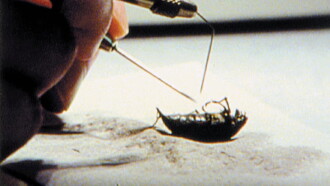
From Stag Beetle to Swastika narrates in a richly detailed, associative montage the boundless possibilities of manipulating images and using images to seduce.
01 January 1993
Young Duke Ernest wants to become a good knight. The circumstances are not in his favour: The emperor wants to claim the Duke's castle and marry his mother.
01 January 1992
The film explores what transformations in power and politics do to art, how much opportunism can be found in “pure” art and whether fascist symbols can ever regain their aesthetic innocence.
01 October 2003
Explores the incredibly complex backstory of Ted Kaczynski, the infamous Unabomber. This exquisitely crafted inquiry into the rationale of this mythic figure situates him within a late 20th century web of technology—a system that he grew to oppose.
01 January 2008
In 1984, the “First Leipzig Autumn Salon” took place – a risk and a caesura for Dammbeck. Bypassing every state institution, six painters, sculptors and filmmakers organised an art exhibition.
07 March 1980
Dammbeck made this film – a reference to the myth of Icarus and a metaphor for failure, hope, and human exploration – at the invitation of the legendary animator Kurt Weiler.
07 July 1978
This short film traces the story of a man from birth to old age. The magical dreams of his youth appear from time to time, but daily routine quickly takes over.
01 January 1981
Dammbeck relocates the Leipzig-based artists' circle known as Herbstsalon to La Sarraz Palace in Switzerland, which in 1929 was the venue of the legendary congress held by important protagonists of new, independent cinema as a forum to discuss issues such as elitist thinking, the taste of the masses, and the difference between art and life.
26 August 1996
Dammbeck, himself an alumnus of the Leipzig Academy for Graphic and Book Design, presents the origins of the new German realism developed by the so-called Leipzig School, which took place in the context of socialist-realist dogma in the GDR before the Wall was built in 1961.
27 November 1981
The very first images in the film set unprecedented standards in East German animated film: a Buñuelean eye that fills the entire screen, real-life sequences of fleeing animals and a sound collage running contrary to what is seen on the screen.
31 January 1989
In this film, Dammbeck explores his own decision to relocate to Hamburg, West Germany, and tries to sort out his past as an artist.
01 January 2004
The source material came from the prosecution, who wanted to use it as a basis. The 120 hours of material from the broadcasts of various US television stations, which the officials of the Sacramento prosecutor's office had recorded (in poor picture and sound quality), were surprisingly made available to Lutz Dammbeck in 2002.
02 November 1978
For the multimedia exhibition Tangenten I (Tangents I), Dammbeck and co-organizer, sculptor and painter Frieder Heinze had planned to collaborate on a film that would combine non-camera animation with 35mm footage of a train ride between the two Dresden districts of Radebeul and Pieschen.
09 March 1984
A little bumblebee is tired of her daily routine and the other boring bumblebees. She flies to the place of her dreams and meets a frog who is also seeking something new.
01 January 1990
Despite seeing his film project HERCULES rejected by DEFA Studios in 1983-84, Dammbeck remained fascinated by the Hercules story.
01 January 1986
This multimedia collage, which includes performances by pantomime artist and dancer Fine Kwiatkowski, painter and filmmaker Lutz Dammbeck and musician Robert Linke, is a reflection on the medium of film and its elements: sound, light and movement.
20 February 1987
Two men sit on an island watching the sunset. When a storm gathers, they decide to build a boat. While one man is mindful of the coming danger and urges speed, the other wastes his time on decorative details.
01 January 1984
Together with Lutz Dammbeck, dancer Fine Kwiatkowski explores myths, political systems and their impact on society.
21 January 1977
The moon swirls happily around, watching strange animals enjoying themselves and dancing to gramophone music in its light.
01 January 2005
In 1985 under the Pseudonym "Hakim Bey" Peter Lamborn Wilson published the book "TAZ: The Temporary Autonomous Zone, Ontological Anarchy, Poetic Terrorism", a cult book for the first generation of hackers and cyberpunks.