Neelon Crawford Trailers
… And the Pursuit of Happiness TrailerKate and Anna McGarrigle TrailerFor the Spider Woman Trailer


… And the Pursuit of Happiness TrailerKate and Anna McGarrigle TrailerFor the Spider Woman Trailer

Total trailers found: 25

01 January 1970
Visually oriented films presented as moving light paintings enabled me to leave the structures and expectations of dramatic and documentary motion pictures aside.
01 January 1969
During the winter of 1968–69, I saw that much of the footage I was shooting was filled with a tension reflecting my own anxieties.
01 January 1977
A portrait of power as natural gas was vented and burned from an oil field in the jungle of eastern Ecuador.
01 January 1977
“The series of South American films...shot in Ecuador in 1976, such as Banana Leaves and Lago Agrio Gas Burn, speak to what one critic had earlier described as “an almost pantheistic reverence for [the] phenomenal world.
01 January 1974
The films shot during 1973–74 in Ecuador, Peru, and Bolivia span a range of interests. Some, like Ship Side Steel Plate Lights and Laredo Sugar Mill, are examinations of visual details.
01 January 1974
Bright sun reflecting off the water’s surface onto the black hull of a cargo ship made a fluid painting with light and steel.
01 January 1971
Influenced by the early theories of Sergei Eisenstein (1898–1948), in Needle at Sea Bottom I sought to create and implied time and space not found in either of the component images…the power of still awareness is literally depicted….
01 January 1977
Another energized detail of a filament in a red electric bulb.
01 January 1969
[…A] tribute to the Sun. It is a celebration of light and water shot in Ohio and while crossing the country to the Northwest during the spring and summer of 1969.
01 January 1969
Mostly animated from 35mm slides, Skyjacker slips to a dream world of Ohio woods, British Columbia winter, and New York.
01 January 1972
[…The] first of a series of one-minute films to replace television commercials.
01 January 1971
On the first and third Saturday of each month, Master Choy Kam-man has a club meeting with all of his students who have completed at least one course in Tai Chi Chuan.
01 January 1976
Shot in Peru in 1974, this is an examination of a vintage mechanical mill crushing sugar cane.
01 January 1976
From two color camera rolls filmmaker Michael Mideke and I shot on July 4, 1969, we began editing many versions, independently and together.
01 January 1971
The material…was shot primarily on the West Coast, some in New York, during 1969–71. Divided into eight sections, Mobius defines a motion from downtown San Francisco through a forest in Los Padres National Forest, a student (Michael Anton) practicing Tai Chi Chuan, to the southern Big Sur coast.
01 January 1979
There is nothing like a summer ride on a legendary Vincent Black Shadow motorcycle to “blow the stink off.
01 January 1977
Making short, silent, single-subject films allows the specific forms and movements to be savored without the burden of a distracting drama or explanation.
01 January 1976
With films such as Passing, Paths of Fire II, and Light Pleasures, the viewer’s retinal after-image is enhanced by the dark frames after bright frames.
01 January 1980
In this film, dancer and choreographer Jane Comfort performs a short dance titled “For the Spider Woman.
01 January 1977
I found the pixel structures in extreme close-ups of my Sony Trinitron television’s screen surface to be an endless source of colorful kinetics, often more interesting than the presented program.
01 January 1971
A chance meeting with contemporary dancer Ishi Kamamoto during a visit to London led to the filmmaker shooting the performer’s improvised dance in natural light alongside a canal which Crawford later edited when he returned to San Francisco.
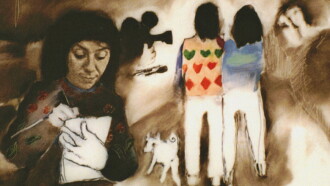
01 January 1981
A short documentary about singers Kate and Anna McGarrigle made by animator Caroline Leaf.

27 June 1986
In 1986, Louis Malle examines the immigrant experience in America by interviewing newcomers from various professions nationwide, highlighting their struggles in a multicultural society.
01 January 1968
I shot my first film on 16 millimeter inside the eight-foot mirrored cube “optical sculpture” I had built in 1966, and on exterior locations, as a blissful celebration of the visual tools and techniques I found at my disposal.
