Nguyễn Trinh Thi Trailers
How to Improve the World TrailerFifth Cinema TrailerEveryday’s the Seventies Trailer
Nguyen Trinh Thi is a Hanoi-based independent filmmaker and video/media artist. Her diverse practice has consistently investigated the role of memory in the necessary unveiling of hidden, displaced or misinterpreted histories; and examined the position of artists in the Vietnamese society.
Nguyen studied journalism, photography, international relations and ethnographic film in the United States. Her films and video art works have been shown at festivals and art exhibitions including Jeu de Paume, Paris; CAPC musée d’art contemporain de Bordeaux; the Lyon Biennale 2015; Asian Art Biennial 2015, Taiwan; Fukuoka Asian Art Triennial 2014; Singapore Biennale 2013; Jakarta Biennale 2013; Oberhausen International Film Festival; Bangkok Experimental Film Festival; Artist Films International; DEN FRIE Centre of Contemporary Art, Copenhagen; and Kuandu Biennale, Taipei.
Nguyen is founder and director of Hanoi DOCLAB, an independent center for documentary film and the moving image art in Hanoi since 2009.

Most Popular Nguyễn Trinh Thi Trailers
Total trailers found: 13
09 September 2021
Resisting the westernised reliance on images for creating narratives, telling stories and experiencing the world, How to Improve the World turns to music and sound as a way of perceiving through listening.
16 August 2012
Set in a factory in Asia during an undefined celebration event, Europeans in suits are seen in long wandering shots as they greet one another, shake hands discreetly, and look about themselves expectantly.
24 November 2018
Explores a subjective understanding of the artist’s homeland, Vietnam. Nguyen interrogates local, official histories and external viewpoints on Vietnam, together with the wider ideals of women and men, the role of the artist in society, and the landscape as metaphor.
01 January 2014
Vietnam the Movie uses a carefully structured montage of clips from drama and documentary films to give a chronological account of Vietnamese history from the mid-1950s to the late 1970s, encompassing the end of French colonialism and America’s involvement in the Vietnam War.
01 January 2012
Set in a factory in Asia during an undefined celebration event, Europeans in suits are seen in long wandering shots as they greet one another, shake hands discreetly, and look about themselves expectantly.
01 January 2013
Composed of found photographs from newspaper reports that show people pointing into a seemingly empty landscape: something often found in Vietnamese newspapers as photographers usually arrive at the scene of an event only after it has taken place.
13 April 2011
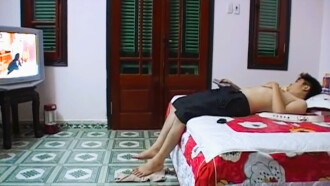
This is a story about Hieu - a youngster who belongs to the 9x generation in Vietnam today. With the pressure of not being understood and the incapability to share with his family, Hieu tries to get away from them, lives on his own, and seeks enjoyment from friendships and other social encounters to fulfill his life with.
31 December 2011
The film uses footage from Trần Đắc’s eponymous feature-length classic produced by the state-owned Vietnam Feature Film Studio.
01 January 2010
Using ‘exquisite corpse’, a method by which each collaborator adds to a composition in sequence, the filmmaker began her journey over the Vietnam War’s notorious Ho Chi Minh Trail.
01 January 2007
Through Master Luu Ngoc Duc, one of the most prominent spirit mediums in Hanoi, and his vibrant community, the film explores how effeminate and gay men in homophobic Vietnam have traditionally found community and expression in the country’s popular Mother Goddess Religion, Đạo Mẫu.
28 January 2016
In Vietnamese artist Thi Nguyen’s tranquil essay film, a letter exchange unveils the changing uses of space in various provinces and the different ways its inhabitants remember history.
23 September 2016
Eleven Men combines footage from a range of Vietnamese classic feature films produced by the state-owned Vietnam Feature Film Studio with Franz Kafka’s short story Eleven Sons.
15 March 2018
Three-Channel Video, Four-Channel Sound, 15 minutes Different versions of the same history – one personal, another depicted by cinema, the third described by the media – are laid on top of each other and collapsed.