Paul Sharits Trailers
Paul Sharits TrailerFuntime at the Vasulkas TrailerAs I Was Moving Ahead Occasionally I Saw Brief Glimpses of Beauty Trailer
Trained as a graphic artist and a painter, Paul Sharits became an avant-garde filmmaker noted for manipulating the film stock itself to create a variety of fascinating, abstract light and colorplays when projected on the screen. Fans hail the effects hallucinogenic, while his detractors find them garish. Sharits is also known for establishing experimental film groups at prominent universities, including one at the University of Indiana where he studied. He later taught and developed an undergraduate film program at Antioch College. Between 1973 and 1992, Sharits taught at the Center for Media Study at the State University of New York. His films can be seen in various U.S. and European museums, film centers, and libraries. Much of his work can be found in the Anthology Film Archives in New York City. ~ Sandra Brennan,
Most Popular Paul Sharits Trailers
Total trailers found: 51
08 November 1981
Reel 13 of Gérard Courant's on-going Cinematon series.
22 January 2015
Long after his premature death, the impact of Paul Sharits lingers on. The prominent iconoclast and innovator provoked with fast-flickering, pulsating, colourful mosaics.
01 January 1985
Home movies shot on Super 8mm by W+B Hein over 10 years.
19 July 2010
Feature-length compilation program presenting 37 out of 41 original fluxfilms produced and directed in the 1960s by Fluxus artists, including George Maciunas, Nam June Paik, Yoko Ono, Robert Watts, Paul Sharits, et al.
06 August 1997
Jonas Mekas assembles 160 portraits, appearances, and fleeting sketches of underground and independent filmmakers captured between 1955 and 1996.
05 November 2000
A compilation of over 30 years of private home movie footage shot by Lithuanian-American avant-garde director Jonas Mekas, assembled by Mekas "purely by chance", without concern for chronological order.
01 January 1976
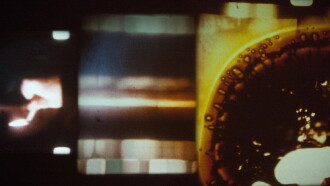
A series of tail ends of varied strips of film, with sometimes recognizable images dissolving into light flares, appear to run through and off of a projector.
20 December 1978
Cinématon is a 156-hour long experimental film by French director Gérard Courant. It was the longest film ever released until 2011.
01 January 1975
Two projectors pulse in tandem
02 February 1982
Three-screen film. On the first screen, close-ups of an agitated match in front of a young woman's fearful face.
01 January 1982
Two reels of mis-takes in shooting Part II of 3RD DEGREE; Film was loaded in camera improperly and the image slides about off-center and becomes blurred, creating some rather amusing and mysterious imagery.
01 January 1971
A mapping of an image of the linear passage of '16mm film frames' and 'emulsion scratches' onto actual 16mm film strip (the unperceived film 'print')/the aural word 'miscellaneous' is extended to a length of 8 minutes by serial fragmentation, looping, staggering and overlaying/a variational but non-developmental strand thru time.
17 December 1968
“The screen, illuminated by Paul Sharits’ N:O:T:H:I:N:G, seems to assume a spherical shape, at times – due, I think, to a pearl-like quality of light his flash-frames create … a baroque pearl, one might say – wondrous! … One of the most beautiful films I’ve seen.
01 January 1971
Streaming, scratched lines continuously appear two at a time over images of flowing water.
17 June 1969
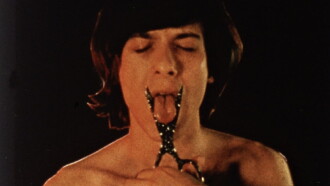
T,O,U,C,H,I,N,G uses flickering frames of solid color juxtaposed with positive and negative still images of a man—sometimes cutting off his own tongue with glitter-covered scissors, sometimes suffering a series of glitter-stained fingernail scratches across the face.
01 January 1976
The films are of two patients, extracted from a medical film study of brain wave activity during seizures.
01 July 1966
The film is a transfixing “flicker” film that distills the cinematic experience to projected light and color patterns, allowing “the viewer to become aware of the electrical-chemical functioning of his own nervous system.
01 January 1974
Sharits produced Color Sound Frames by rephotographing strips of his previous films. He moved the strips, singly and in pairs, across a light table in front of the camera at various speeds.
01 January 1966
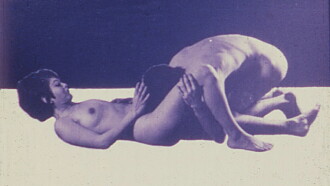
Blank color frequencies space out and optically feed into monochrome images of one lovemaking act which is seen simultaneously from both sides of its space and both ends of its time.
01 January 1978
The visual "degeneration" of the image ... through successive rephotography is paralleled by the compression of verbal information to the point of its loss of legibility; yet, both the "degenerated" sound and image are perceptually engaging, even in the most advanced stages of "degeneration".
25 December 1973
"There is a paradox in such artistically special (and significant) films as Sharits' very real and reflexively beautiful AXIOMATIC GRANULARITY.
01 January 1974
Footage of a strip of damaged film.
01 January 1976
Like ANALYTICAL STUDIES I, these short works each develop a different rhythmic and/or melodic idea using only rapid successions of color frames.
01 January 1976
Film by Paul Sharits presented as double projection theatrically and quadruple projection in galleries.
25 September 1974
The film consists of seven sections: the first section, "Specimen I," a "flicker" film, is the subject for the other sections of ANALYTICAL STUDIES III.
01 January 1987
'Rapture' is a fierce vision of a Dionysian experience, a tightly controlled visual statement about the abandonment of self to heightened transportive states.
01 January 1976
A flicker film of colorful squares.
01 January 1981
2 screen projection
01 January 1975
Particles throb in three dimensions.
14 February 1977
The film consists of two identical prints shown simultaneously, one projected inside the image of the other.
03 June 1975
The images for this project were first obtained by enlarging, with an optical printer, frames of evenly distributed grain particles from a black and white strip of underexposed 8mm Tri-X film.
01 January 1984
A chronicle of Sharits' 1977 visit to Romania to experience three of Brancusi's most famous sculptures.
01 January 1974
Paul Sharits short work
01 January 2006
A recording of a meeting in the studio where Jeffrey Schier and Woody show colleagues and teachers a new tool.
01 March 1972
Sound Strip / Film Strip is Paul Sharits' first "Locational" work, made in collaboration with Bill Brand.
01 January 1977
“Freud established that jokes were structurally akin to dreams in their use of condensation, displacement, representation by opposites, punning and ‘nonsense’.
01 January 1968
In Razor Blades, Paul SHARITS consciously challenges our eyes, ears and minds to withstand a barrage of high powered and often contradictory stimuli.
01 January 1966
Single frame exposures of words.
01 January 1965
Various gestures of hand held razorblade, single frame exposures.
01 January 1965
Single frame exposures of dot-screens.
01 January 1965
Toilet paper event, single frame exposures.
01 January 1965
Each film frame is a different image from the Sears Roebuck mail order catalogue. The film places pis
01 January 1971
A highly varied and playful series of short sketches involving induced camera "mistakes," printing "errors" and various "assaults" upon film (some rephotographed) which in one way or another reveal the process/materiality of cinema.
01 January 1971
A set of short pure color studies, usually exploring one dominant hue. Most of these works were studies for longer projects.
01 January 1962
Discovered in summer of 1985, of a set of “haiku-imagistic films” I did before coming to my characteristic style, as in Ray Gun Virus; I thought I’d destroyed all these pre-pure films, in about 1969-1970, the time of my separation from my first marriage.
01 January 1979
While composed of pure/blank color frames (often “flickering”), this is not a “Structural Film”; there’s no predetermined overall structure to the work (which is, anyway, only “chapter one” of a sort of “abstract novel” in progress, a novel which can become extremely lengthy in its projected series of chapters, a novel with a beginning, a middle but no preconceived ending).
01 January 1971
The footage, in order of appearance, is: 1. rock strata – along the banks of the Niagara River, before it empties into Lake Ontario, 1975, while an artist-in-residence at Artpark, Lewiston, N.
16 May 1976
This is a rare video interview with one of America’s finest film artists, shot in New York towards the end of his abruptly terminated career.