Paul Winkler Trailers
Bean::Queen TrailerBarbie and Friends TrailerMorbid Sheep Trailer
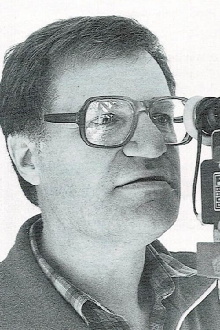
Paul Winkler is a German-born Australian filmmaker who lives and works in Sydney. He was associated with Corinne and Arthur Cantrill, Albie Thoms and David Perry in pioneering local experimental film production in the 1960s.
Winkler characterises his films as "a synthesis of intellect and emotion, filtered through the plastic material of film". "I try to let 'imagines' flow freely to the surface". The ideas which he terms ‘imagines’ may reflect Australian icons like Bondi Beach, Ayers Rock/Uluru and the Sydney Harbour Bridge, or textures, as in Bark/Rind, Green Canopy, and the bush.
In 1973, Winkler's film Dark identified with the Aboriginal land rights movement, acquiring a spirituality which was also manifested in Chants and Red Church. Later films take contemporary society for their subject, as in Rotation, Time out for Sport and Long Shadows. His early apprenticeship is recalled in Brickwall, Backyard and Brick and Tile.
In 1995, the Museum of Contemporary Art and Sydney Intermedia Network mounted a retrospective screening of 30 of his films. The following year, the Carpenter Center for the Visual Arts, Harvard University, USA screened 30 films in a three-day retrospective. The Museum of Modern Art in New York, USA holds 15 of his films in their collection.

Most Popular Paul Winkler Trailers
Total trailers found: 43
01 January 1979
“I don’t drive, but I know people who’ll drive 100 metres to go to the shops. Our society is obsessed with the car, with coming and going, getting somewhere.
01 January 2000
Sydney, a city turning itself upside down to get ready for the year 2000. The Olympic Year.
01 January 2017
A mob of sheep are going into a very uncertain future.
01 January 2011
A lyrical montage of juxtaposed street-art images, set on rotating surfaces and against a percussive soundtrack, to hint at the tribal nature of street art.
01 January 1967
“An impressionistic documentary. Black and white, alcoholics, blind people, wheelchairs...the down and out in Sydney.
01 January 1991
“I was fascinated by the distance Australia has travelled in the past 50 years, and by how this evolving complexion continues to be indelibly, almost unconsciously, recorded by simple family and tourist images (today via video camera).
01 January 1984
“I made this film in the heyday of the ‘80s... a lot of people spending and making a lot of money in a kind of mad frenzy.
01 January 1988
“A friend had given me some old footage shot in Germany pre-WWII...during the ‘30s. Among all the images of sport, and people dancing, were images of Hitler making his early speeches.
01 January 1983
“You can have a weatherboard house, a fibro house, or a brick and tile house. Here in Australia real estate is very strong, and ‘brick and tile’ is what we call a solid house.
01 January 1997
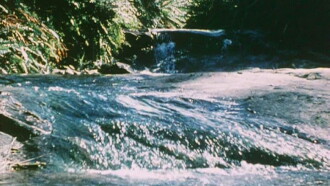
The movement of water via capillary action - the phenonema of water flowing uphill is made visible through the artificially induced osmosis of push and pull of dissimilar photographed material.
01 January 1987
“I was interested in how people behave at street crossings… particularly at ‘Walk’ and ‘Don’t Walk’ signs.
01 January 1993
“Having lived here for so long, enjoying the Sydney coastline, I wanted to pay homage to it. I’d always been intrigued by the intricate natural and artificial shapes of the city’s Eastern harbour (eg the Woolloomooloo Finger Wharf and Pyrmont) and its ocean headlands and beaches.
26 December 1974
“Using footage shot during the first Aboriginal Land Rights demonstrations in Sydney, and when the police tore down the ‘Aboriginal Embassy’ in front of Parliament House in Canberra, Dark juxtaposes this violent struggle with images (taken from a tourist slide) of an old Aboriginal warrior imprisoned, in his mind, in his own country.
01 January 1964
“I was playing with colour, and its emotional effect...green for hope, red for violence, blue for a bit of mystique—a very dark purplish orange blue.
01 January 1982
“Some had given me an iris—a little gadget which opens and closes—they were used a lot in silent movies to indicate the beginning or end of a scene.
09 June 1994
“Somewhere I read a headline ‘One million trees will be chopped down’ and I was absolutely horrified.
01 January 1990
“Sydney. Another symphony of the city...inspired by the hectic, rollercoaster times. Buildings were going up left right and centre.
01 January 1969
“I was in Germany again because my father had died, and I was at his grave. Flashes of terror struck me for fractions of a second, which I immediately tried to forger.
01 January 1979
“A woman stands ironing near a window. You never actually see the ironing, but you experience the repetition and the boredom.
29 April 1998
A journey into the threshold of pain via a symphonic onslaught of colour and sound.
01 January 1975
“After three very hectic films, I needed something to soothe my nerves. I came across these Coptic crosses in a Greek souvenir shop.
06 June 1977
“Tourists, postcards, different views of the same icon. The Bridge is a piece of geometry so I figured the film had to be geometric, too.
01 January 1968
“By this time we had a Filmmakers' Cinema here in Sydney. I made the film on the spur of the moment.
01 January 1980
“The expansion of Sydney and its encroachment on the surrounding Bush. Inverting this imagery so that the Bush is surrounded by the City.
25 September 1975
“Being a bricklayer, this was one of my most important films. It represents eight hours of work...you start your early morning, you look at the work which is in front of you—then you get stuck into it—you have a morning tea, then you have lunch—and in the afternoon, of course, you knock off.
01 January 1976
“I wanted to make a sequel to Chants…the gold against black, but I wasn’t quite sure how. One day I went to St Mary’s Cathedral here in Sydney.
01 January 1971
“The destruction of trees in Sydney...chainsaws, the trees really screaming out. Rapid zooming, often close up shooting.
01 January 1980
“I lived in Darlinghurst [central Sydney] at the time. The hustle and the bustle of that section of the city intrigued me.
07 August 2018
Winkler makes his transition from film to digital in this irreverent, amusing and absurd examination of icons from popular culture and the plastic baubles mass-produced in their image.
01 January 1976
“This was my first film using the matte-box. Using images of my own backyard, I found that I could create a kind of mysterious story, an almost supernatural effect.
01 January 1979
“One day at the beach…a typically Australian day…something I really looked forward to, when I first came here as a migrant (Bondi was the first surfing beach I’d ever seen).
01 January 1970
“I now knew that I'd found a style to interpret an emotional event filmicly. The unabating atrocities of the Vietnam War, the growing protest movement in Australia, and the ghastly images we witnessed each day in newspapers and on TV formed my material.
01 January 1981
“For many years I had wanted to visit the Rock, but I had never really had the means. A little funding from Germany finally got me there.
01 January 1977
“I wanted to make grass grow...to show the life force of a tree. Bark-Rind was shot totally single-frame.
01 January 1986
“When you walk through the Bush, you hardly ever see any animals—they tend to take cover long before you actually come anywhere near them.
01 January 1980
“A totally artificial city created entirely in camera. There is virtually no sky…just a city gone mad and town planning berserk.
29 April 1996
A short piece of found footage is optically reworked as text versus imagery versus the spoken words of a 'narrator' telling the audience a story of a famous golf player.