Pedro Chaskel Trailers
Nada pertenece a la memoria TrailerCantata de Chile Trailer
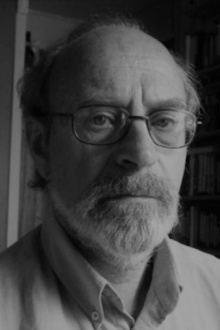
Pedro Chaskel, is one of the main precursors of the so-called New Chilean Cinema, as a director, cameraman and editor of numerous short and feature length films.
An early emigrant from Germany at the age of seven, Chaskel became a Chilean national in 1952, and studied architecture at the Universidad de Chile from 1951 to 1954.
That year, he became a founding member and animator of the Cine Club Universitario de la Federación de Estudiantes de Chile (FECH). A conspirator in the exhibition of films that did not come to Chile through the regular commercial circuit, Chaskel promoted, together with a group of contemplative people, a custom that was not very common in Chile: the cinema forum, or the debate organized after the film screenings that he did at the Central House of the Universidad de Chile. It was there that classics of German expressionism, Italian neo-realism and any film they had available were shown for the first time in Chile.
In 1973, due to the military coup suffered by the government of President Salvador Allende, Chaskel is expelled from the Universidad de Chile by the military authorities, and travels abroad.
Between 1974 and 1983 he settled in Cuba, where he worked as an editor at the Cuban Institute of Art and Cinematographic Industry (ICAIC), and since 1979, as a director and filmmaker for the same institute.
In 1983, he returns to Chile. He works in film and video as an independent professional, working as an editor and director of documentaries.
From 1997 to date, he has taught film at many Chilean universities.

Most Popular Pedro Chaskel Trailers
Total trailers found: 44
01 January 1965
Sequences that illustrate moments in a woman's life, in parallel to the political events happening in South America during the 60's.
21 May 2015
A female mutt called "Perla" (Pearl) is abandoned by her owner on the top of the San Cristobal hill, in the capital city of Santiago, Chile.
04 December 1967
Feature film that wraps, through Jorge Lillo's text, three short films by Helvio Soto
10 December 1957
Set in Santiago de Chile in the 50's and divided into three stories. The first story is about a young woman who has just discovered that she's pregnant.
23 October 1976
The story of the Santa María School massacre of miners in 1907.
12 November 1969
This documentary shows the inhuman conditions on which the patients of Iquique's Psychiatric Hospital live.
15 June 2000
Examines the mind and work of artist Juan Luis Martinez. Martinez's contemporaries expound upon his of reality and the political climate in Chile.
13 March 1976
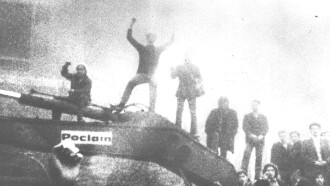
Chronicles the events immediately surrounding the CIA- supported coup itself.
18 March 1975
The chronicle of the political tension in Chile in 1973 and of the violent counter revolution against the democratically elected government of Salvador Allende.
15 March 1979
Guzmán’s final installment shifts from covering the actions of Allende’s opponents to those who battled to revive & promote their toppled leader’s vision for a new Chile.
19 October 1965
A docudrama based on the family planning policies for the population with limited resources. A low-income lady resorts to clandestine ways to get an abortion.
15 September 1961
A family on the brink of bankruptcy decides to do dirty jobs undercover by the government to overcome their condition.
09 July 1989
Three stories rooted in violence, mental erosion and hopes that ran through Chile's soul.
03 August 1965
A maid loses all her jobs because her son cries at night, and that bothers her bosses. The play portrays the wandering and desperation of the protagonist to get a job, which ends in her failed attempts due to the "Angelito".
01 January 1981
Documentary about the iconic portrait of Ernesto 'Che' Guevara by Cuban photographer Alberto Diaz Gutiérrez (known as 'Korda').
11 September 1973
It portrays young people from different social and political classes, and collects their impressions of the context in which they live.
17 June 1971
A documentary about the consequences of consuming alcohol and how it works as a weapon of the bourgeoisie to appease the thirst of the people.
03 August 1965
Two guerrillas (Miguel Littin and Jorge Guerra) wander lost in the desert until one of them dies. A jeep appears in the distance to rescue the survivor, but unable to read the signs of comradeship pointed out to him by the drivers of the vehicle, he shoots them.
06 January 2023
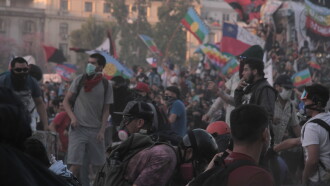
La Revuelta accounts for the tension experienced by those who, as of October 2019, came out to express their social discontent.
07 April 2015
Documentary that explores the "Archives of Horror" of the General Alfredo Stroessner's dictatorship, discovered in Paraguay in 1992 and in the documentation of Operation Condor found there, which reveals who was responsible, their goals, strategies, accomplices and murders.
06 July 1980
Confused faces of children, women and men when asked about the meaning of “eviction”, “unemployment”, “begging”, “gambling” and “racial discrimination”, all problems eradicated in Cuba after the 1959 Revolution.
23 January 1964
A poetic film that records the excavations carried out by Swiss ethnologist Jean Christian Spahni at the mouth of the Loa River.
12 November 2017
Pedro Chaskel, director, editor and post-producer. Based on domestic memories, and accompanied by representative fragments,tries to reconstruct the most important works of his career and motivations.
16 November 1958
Record of the landscapes of the Antarctic continent and of the scientific activities carried out there in mission of the executive committee for the International Geophysical Year.
30 October 1985
SOMOS + follows a political demonstration by women who rise up with a unified voice against Pinochet’s military regime.
21 January 2014
The documentary frames the reactions of Rapa Nui's people following the screening of -at that time- a presumed lost film involving their territory.
03 August 1965
A poet recites his verses. The people who listen to him, inspired by him, form the Spring Party, which later becomes the Spring Army.
03 December 1979
Latin American children, children of exiles and political prisoners, tell of their experiences of integration in Cuba, sharing their memories from exile and ideas on politics and education.
06 November 1962
Detailed record of the operative technique used by Professor Dr. Alfonso Asenjo to perform surgery on a patient with Parkinson's disease at the Hospital de Neurocirugía de Santiago.
24 October 1979
A documentary about the activities carried out by the Group of Relatives of Disappeared Detainees: We see presentation of writs of protection, reports, criminal actions, hunger strikes, pacific protests, public acts.
04 May 1970
Based on an actual murder case that ignited a furious debate over the death penalty in Chile in 1960, this experimental social drama portrays the life and death of an illiterate peasant who, while drunk, murdered the woman with whom he had a relationship and her five children.
20 September 1970
A collage of images showing the two faces of a society. That of poverty and that of wealth. Throughout the documentary, this antagonism is shown: populations in unhealthy conditions, and on the other hand, large showcases with mannequins.
01 January 1983
A sound system plays Commander Ernesto Guevara's speech, delivered on October 20, 1962, during the Second Anniversary of the Young Communist League, along with a series of archival images of the revolutionary leader visiting factories and meeting with workers.
01 January 1971
Through the testimony of the victims of the Brazilian dictatorship, and the re-creation of the practices to which they were subjected, the torture suffered by the Brazilian political detainees in their country is denounced.
28 April 1964
A boy goes to his friend's funeral procession. When he realizes that his grave does not have flowers like the others, and that he does not have money to buy them, he goes out looking for some in the streets of Santiago.
09 March 1961
A day in the life of an 'organillero' as he plays his music in the streets of a Chilean city.
01 January 1982
Cuban workers remember Che Guevara. They testify to his relationship with the workers, his good example, and his great capacity for work.
04 June 2008
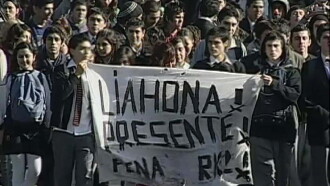
Between April and June 2006, nearly one million Chilean high school students captivated the nation as they organized in protest and temporarily placed many schools on strike.