Pere Portabella Trailers
Constel·lació Portabella TrailerEls tapissos de Miró TrailerPoetes, 50 anys després Trailer
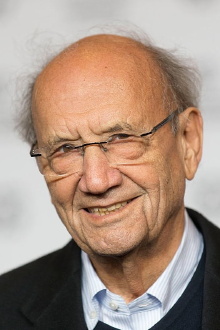
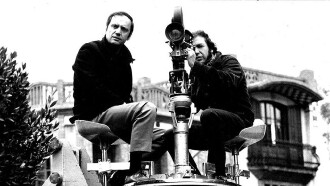
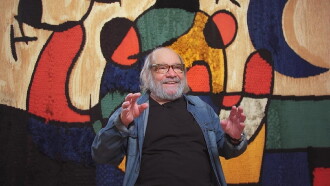
Pere Portabella (born in 1927) is a Catalan director, producer, and politician. In 1977, he was elected Senator in Spain's first democratic elections and participated in the writing of the Spanish Constitution. As a filmmaker, his style is experimental, reaching new aspects of film language, often with a poetic tone and social content. Portabella is hailed as an essential figure in the political and cultural history of Spain.
Most Popular Pere Portabella Trailers
Total trailers found: 51
07 December 1977
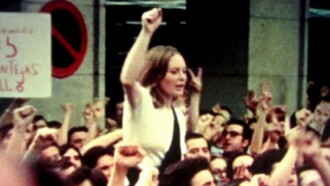
How does a country go from a dictatorship to a democracy? A detailed report on the political representation in the heart of the Spanish Transition, only a few months after General Franco’s death, when the sincere democratic vocation of Spanish people must effort to destroy, one heavy brick after another, the wall that those who supported the dictatorship and those who fought it from the exile built with resentment, hatred and prejudices.
15 September 2006
What is the state of cinema and what being a filmmaker means? What are the measures taken to protect authors' copyright? What is their legal status in different countries? (Sequel to “Filmmakers vs.
15 October 1986
A Pepe Carvalho adventure.
31 October 2003
a one-woman stage reading of a Joan Brossa play
03 April 1969
Without a family, penniless and separated from her sister, a beautiful chaste woman will have to cope with an endless parade of villains, perverts and degenerates who will claim not only her treasured virtue but also her life.
03 November 1960
Don Anselmo, a retired old man, decides to buy a motorized disabled stroller since all his pensioner friends own one.
01 January 1973
Commissioned by the Maeght Gallery with the exhibition of Joan Miró, organized by the French Ministry of Cultural Affairs at the Grand Palais, which opened on May 17, 1974 in Paris.
01 January 1970
At underground film of the 1st Popular Festival of Catalan Poetry filmed in the Proce Theater in Barcelona on May 25, 1970, in solidarity with political prisoners.
09 March 1969
With musical accompaniment from the zarzuela 'The drum Grenadiers' by Ruperto Chapí, a pair of custodians are in the basement of the National Library of Madrid showing some canvas awarded with the National Prize for Painting between 1941 and 1969.
01 April 1962
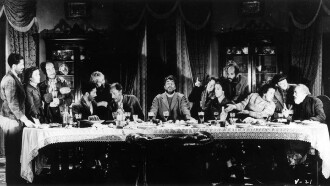
Viridiana is preparing to start her life as a nun when she is sent, somewhat unwillingly, to visit her aging uncle, Don Jaime.
19 May 1972
An unprejudiced portrait of Spanish folklore and a crude analysis in black and white of its intimate relationship with atavism and superstition, with violence and pain, with blood and death; a story of terror, a journey to the most sinister and ancestral Spain; the one that lived far from the most visited tourist destinations, from the economic miracle and unstoppable progress, relentlessly promoted by the Franco regime during the sixties.
07 June 1969
David is a physician who returns to Spain 30 years after his involvement in the Spanish Civil War. Now a member of a medical convention, he looks up old friends and finds his former lover, now a married woman with a flamenco-dancing daughter.
05 May 1972
An atmospheric essay, which is an alternative version of Count Dracula, a film directed by Jess Franco in 1970; a ghostly narration between fiction and reality.
03 March 1965
Miguel, a poor young man living in Franco's Spain becomes a bull fighter to escape poverty.
01 March 1990
A female professor, a writer, and an orchestra conductor--three characters, two couples--attend a grand literary cocktail party.
04 May 1972
This film turns on two basic axes: the inquiry into ways of cinematographic representation and a critical image of official Spain at the time of the Franco dictatorship.
14 May 1960
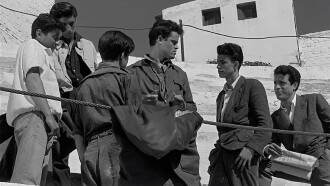
A group of friends who are struggling to survive in the slums of Madrid commit petty crime in order to finance the debut as a bullfighter of one of them.
12 November 2004
A multi-part feature on the governing body of Spain, the Popular Party under Jose María Aznar. Themes include the bombing of Iraq, immigration, U.
13 December 1997
Experimental silent homage to the origins of cinema, recreating the apparent disappearance of a French photographer in the 1920s.
01 January 1969
While waiting to get started on the production of his feature Liberxina 90 (1970), Carlos Duran shot this short (with very expressive support by several Escuela de Barcelona professors): a grimly colourful satire on modern society as such, and on its fascist Spanish variety in particular.
17 November 1967
Pere Portabella’s first work as a director starts with the following phrase: “defeated…but not conquered”.
09 June 2000
Surrealist master Luis Buñuel is a towering figure in the world of cinema history, directing such groundbreaking works as Un Chien Andalou, Exterminating Angels, and That Obscure Object of Desire, yet his personal life was clouded in myth and paradox.
01 January 1967
Conceptual short film consisting of four independent pieces, filmed in Carles Santos' own apartment, on Madrazo Street in Barcelona.
01 January 2006
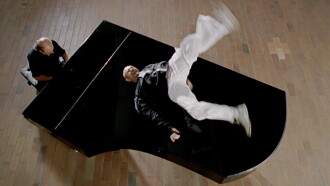
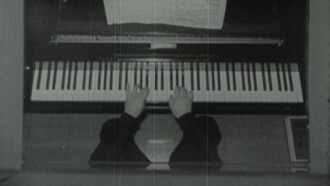
Carles Santos plays several of his pieces on the piano. This film was made for the exhibit on Carles Santos Visca el piano! held at the Miro Foundation in the summer of 2006.
01 July 1969
Portabella’s first feature, co-scripted by poet Joan Brossa, became one of the most influential works of the Barcelona avant-garde, although like all his early films, it circulated only in an underground fashion.
01 January 1973
The film was conmissioned by the Galeria Maeght to commemorate the Joan Miró exhibit organized by the French Minsitry of Cultural Affairs in the Grand Palais in Paris that opened on May 17, 1974.
27 July 2020
Eight people from very different backgrounds cross paths in Barcelona, Spain. Lawyers, musicians, translators, security guards, call center agents.
05 September 2024
Constel·lació Portabella traces the exciting life of the great Catalan film director and artist Pere Portabella , which traverses the cultural and political history of the country and the last seventy years, letting us be carried away by the passion, the intellect intelligence and curiosity.
01 January 1992
An itinerary through the great creations of Catalan art: Romanesque, Gothic, Modernist and Contemporary; with interviews to Catalan creators such as architect Ricardo Bofill, poet Pere Gimferrer, sculptor Susana Solano, and painter Antoni Tàpies.
01 January 2003
Naked bodies are buffeted by water accompanied by the music Il Temporale from the opera La Cenerentola and the overture to Il Barbiere di Siviglia both by Gioacchino Rossini.
01 January 1970
Short film by Spanish/Catalan film maker Pere Portabella.
01 January 1969
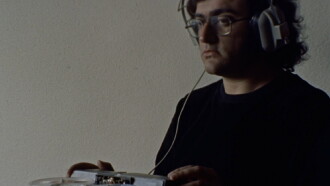
A tape recorder captures a voice (the narration is by Pere Portabella) rigorously and exhaustively reading all the symbols that appear in the piano score of Chopin's piece.
01 January 1973
The film is divided into two antithetical segments ‒ The first is made up of a couple of fixed shots of the pianist, Carles Santos, playing Chopin's Prelude in C-sharp minor, Op.
04 December 2008
"Mudanza" (Removal) came to be made after the curator Hans Ulrich Obrist was asked for involvement in a project in the Huerta de San Vicente, the home and museum of the García-Lorca family in Granada.
01 January 1967
The first of the conceptual short films directed by Carles Santos and produced by Pere Portabella. Here, only the soundtrack allows us to know what is happening.
08 August 2016
A documentary about the technological progress responsibility in employment destruction, analyzed by philosopher Zygmunt Bauman and others.
05 October 2017
In 1969, Jesús Franco and Christopher Lee shot Count Dracula in Barcelona. At the same time, Pere Portabella became aware of this filming, vampirizing it in Cuadecuc, Vampir.
21 December 2007
A beautiful, sometimes faintly bonkers celebration and contemplation of the role Bach’s music plays in the world today.
01 January 1969
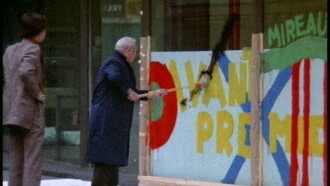
As publicity for the exhibit Miró L’altre, organized by the Colegio de Arquitectos de Catalunya in 1969, the Board commissioned Pere Portabella to film Miró painting the “poster” for the exhibit on the ground floor windows of the building.
02 March 1974
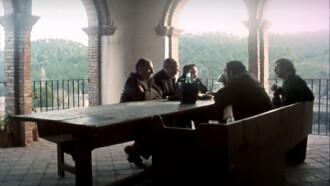
Five ex-political prisoners meet secretly in a country house one afternoon in 1974 on the same day that Salvador Puig Antich is executed, to talk about their experiences in prison.
03 December 2015
Portabella is putting forward the second part of one of his historic works, the “General report on certain matters of interest for a public screening”, which peeked out in 1976 at the start of the political transition process after Franco’s death.
01 January 1969
The Colegio de Arquitectos de Catalunya commissioned Pere Portabella to make this film for the Joan Miró retrospective exhibit in 1969.
11 December 2004
The film is part of the feature film "Hay motivo", made up of 32 short films directed by Spanish directors and actors against the policies of the Partido Popular just before the 2004 elections.