Philippe Grandrieux Trailers
Back to Sarajevo Trailer
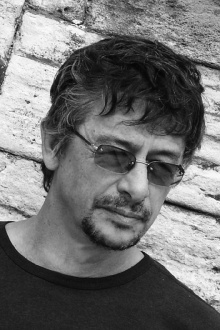
Philippe Grandrieux (born 10 October, 1954; Saint-Étienne) is a French filmmaker. His work covers several cinematographic fields : TV experimentation, video art, research movie, film essay, documentary and museum exhibition.
His uncompromised vision of Art, leads him to push the boundaries of the cinematographic fields he is working on. Following the work of Teinosuke Kinugasa, Jean Epstein and Pier Paolo Pasolini who were constantly looking for and inventing new narrative forms that would only fit films, Grandrieux’s films, deriving from horror movies and experimental movies, give the viewer intense sensorial experiences. His goal is to make the viewer psychologically involved in his movies. Its films actually express a whole world of energies based on sensations and affects despite a linear narration and an iconography that relies on archetypes that refer to the archaic images of the fairy tale and the legend.
Most Popular Philippe Grandrieux Trailers
Total trailers found: 39
20 September 1975
An early Super 8 film by Philippe Grandrieux
01 January 1982
A handheld video camera explores image-surfaces as a visual collective unconscious: a TV screen, Polaroids, photos.
28 September 2019
An installation presented on 11 screens featuring nude human figures engaged in cathartic performance.
06 August 1998
A serial killer stalks a woman he befriended after her car broke down.
27 November 2002
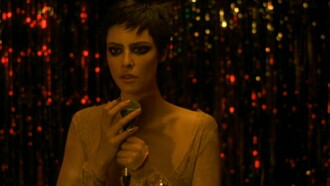
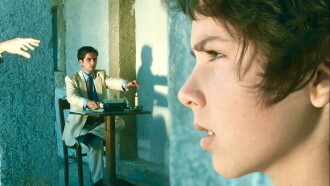
A young American drifts through a decaying Eastern European city, where his fixation on an elusive woman pulls him deeper into an underworld fueled by possession.
06 July 2016
After returning to Paris, a heartbroken man searching for his missing lover finds solace, and a passionate but troubled love, with a grieving nurse.
11 July 2017
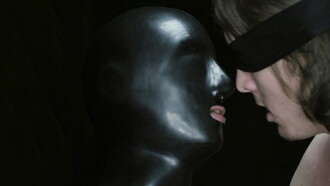
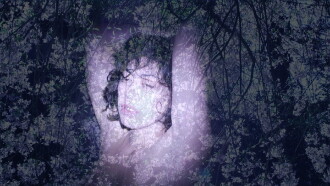
Unrest is the third movement of a triptych by Philippe Grandrieux whose common thread is anxiety. A body as a return from the depths of time, an archaic body that we do not know and which nevertheless continues to project in us its shadow, its anxiety.
01 January 1986
Jim is a small child who lives in an inn run by his parents. The arrival of a strange captain to the Island they live will trouble his existence and tip him into an universe of adventures.
01 May 2007
Inspired by the dominant motif of the novel by the great Austrian writer Adalbert Stifter, "L’Arrière-saison" is a diptych about roses.
04 June 1983
Extract from the program "Juste une image" produced by Thierry Garrel and directed by Philippe Grandrieux.
01 January 1994
Portrait of a popular game in Brazil
01 January 1989
For a series of programs made for TV Fnac, Philippe Grandrieux meets different people who tell us, each in their own point of view, a story of images.
01 January 1989
Third part of an experimental television program led by Grandrieux questionning TV flux aesthetic, this film focuses on a single interview with Jean-Louis Schefer who delivers his hypothesis on man-made images of itself.
01 January 1996
Portrait made for the magazine Brut.
23 July 2020
A FICUNAM commission for four directors, Liminal seeks to play with poetic affinities between film and music.
20 October 1981
Commissioned for the French television series Regards Entendus, La peinture cubiste is a multilayered, elusive investigation of the perception of reality and representation through cinema, painting and video.
01 September 2008
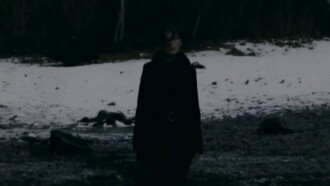
The action unfolds in a country about which we know nothing, a land of snow and forests, somewhere in the North.
30 June 2015
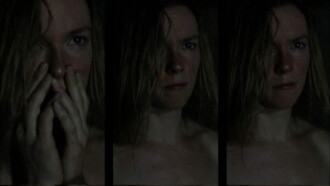
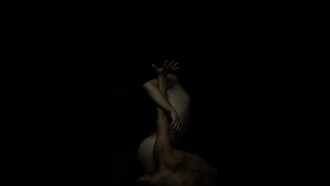
In the second part of the trilogy on anxiety (in continuation of White Epilepsy), the only light source that reflects on the screen is the naked human body.
07 July 2012
Where do images come from? This disturbing and essential question is posed by Philippe Grandrieux, and he already imposed it on himself the start, via Sombre (1999) up to the portrait recently devoted to Masao Adachi (FID 2011).
08 July 2011
The first in a planned series of films about radical filmmakers by film critic Nicole Brenez and filmmaker Philippe Grandrieux, It May Be That Beauty Has Strengthened Our Resolve is a portrait of Masao Adachi, who emerged during the Japanese New Wave of the 1960s as a screenwriter for Nagisa Oshima and Koji Wakamatsu, and directed a series of avant-garde films that grafted radical politics to the sexploitation genre.
30 April 1996
A week after the Dayton accords, Phillipe Grandrieux visits Sarajevo accompanied by Sada, a Bosnian who is returning home after four years of exile.
09 April 2023
In the vision of Philippe Grandrieux, the director of Tristan und Isolde, the latter is the driving force behind the passionate drama of Tristan and herself.
01 March 2018
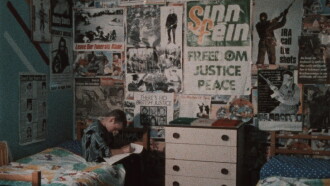
An Irish filmmaker grapples with the legacy of his estranged father, the late documentarian Arthur MacCaig, through MacCaig's decades-spanning archive of the conflict in Northern Ireland.
15 October 2013
Nada and Rabieh are a Palestinian couple living far from the possibility of a homeland. A meditation on time, memory, and the distance from a dream.
01 January 1980
It was made by a group of filmmakers- three men and three women- just to catch a glimpse of a stylish milieu unknown to most.